

Pilates back pain solutions matter to many. Practitioners love the reformer, mat, and tower. They hate that twinge when they roll up, bridge, or leave the Cadillac. If you work in the U.S., balance studio classes, Zoom sessions, and a desk job, you know that small technique slips can cause lasting discomfort. This guide supports Pilates practitioners who use the method to care for their spine, recover safely, and stay active rather than sit out.
Why Pilates back pain shows up—even in “strong” bodies
Pilates earns praise for core control and spinal motion. Yet Pilates back pain happens.
Practice causes include:
• Overusing big muscles (hip flexors, superficial abs, back extensors) while deep stabilizers work less.
• Forcing range in Roll Up, Teaser, Swan, or deep extensions.
• Leaning on joints instead of using slow, controlled lengthening.
• Fatigue at class end, when precision drops but choreography goes on.
Many practitioners have the strength to finish advanced moves but lack the control to support their spine. The answer is to return to gentle patterns that let tissues rest before building strength again.
Safety first: when to pause and seek help
Before you try exercises, check these signs:
• Your pain is sharp, sudden, worsening, or comes with numbness, tingles, or weakness.
• You had a fall or accident, or your pain wakes you at night.
• You are unsure if you should move at all.
Speak with a healthcare professional—a PT, DC, or MD—before you change your practice. Remember, Pilates teaches movement. It does not replace personalized medical care.
When you get clearance, use the gentle, method-based approach that follows.
Principles for using Pilates to relieve back discomfort
When managing Pilates back pain, focus on simple principles over choreography.
1. Neutral spine instead of “imprint everything”
Teachers often cue imprint in early work. Yet living in constant tilt may irritate some backs. During recovery, aim for:
• A neutral pelvis in supine, on all fours, and standing.
• A light abdominal wrap that supports without forcing a brace.
• A lumbar that stays active. It should not get pressed down or pulled into deep extension.
2. Deep core, not just “strong abs”
Your spine needs help from deep muscles:
• Diaphragm
• Pelvic floor
• Transversus abdominis
• Multifidi
Imagine them as a tight 360° support around each vertebra. They should engage gently and steadily rather than grip aggressively.
3. Length before load
If your back feels compressed, then first choose:
• Axial elongation—grow tall from tailbone to crown.
• Lighter springs and shorter levers (bend the knees; keep arms close).
• Small ranges of motion with exact control.
Only when your spine feels secure should you add heavier springs and longer levers.
Gentle mat sequence for Pilates back pain relief
Use this sequence at home or as a studio warm-up. Move slowly. Avoid pain. Stay in comfort. Rest as needed.
1. Constructive rest with diaphragmatic breath
• Lie supine with knees bent and feet hip-width. Keep the pelvis neutral.
• Place one hand on your belly and one on your side ribs.
• Inhale. Let your ribs expand in all directions.
• Exhale. Feel a gentle wrap around your waist. Let your pelvic floor lift slightly.
Repeat 8–10 breaths. Do not force. Let calm return through a full, even breath.
2. Pelvic clocks
• Lie supine with a neutral pelvis.
• Picture your pelvis as a clock face.
• Tilt gently toward 12 o’clock (navel) and 6 (pubic bone). Then move toward 3 and 9.
• Make each tilt small, fluid, and free of pain.
Do 1–2 slow circles in each direction to ease lumbar mobility.
3. Supported marching
• Remain neutral. Rest your hands on your hip bones to sense stability.
• Exhale. Lift one foot to a tabletop position without tilting your pelvis.
• Inhale. Return the foot steadily.
• Alternate your legs.
Perform 8–10 slow reps. If your back tightens, make the movement smaller.
4. Mini bridge for glute activation
• Lie supine with feet under your knees and your pelvis neutral.
• Exhale. Engage your abs. Press through your heels. Lift the pelvis a few inches. Do not lift so high that you lose rib connection.
• Inhale. Breathe into your sides at the top of the bridge.
• Exhale. Lower your pelvis slowly from your mid-back to your sacrum while staying long.
Try 6–8 bridges. Stop if you feel low-back compression. Adjust range or focus more on your hamstrings and glutes.
5. Single leg fall-outs
• Lie supine with your feet flat and pelvis neutral.
• Exhale. Engage your deep abs for stabilization.
• Inhale. Let one knee slowly fall to the side. Keep your pelvis stable.
• Exhale. Bring your knee back.
Do 8–10 reps on each side. This move challenges your anti-rotation control, which is key for daily life.
Reformer modifications for sensitive backs
When back pain lingers, try these Reformer adaptations that are soft on tissues:
Footwork: adjust springs and pelvis
• Choose a moderate spring load that gives you length and avoids compression.
• Work in a neutral pelvis most of the time. Sometimes explore a gentle imprint if that feels better.
• Feel even pressure through your toes and the back of your pelvis.
Short spine/long spine: consider pausing
These exercises can stress an irritated back. Instead, switch to:
• Simple hip lifts with feet in straps in a small range.
• Frogs and circles with low springs and a comfortable mid-range.
Long box versus prone extension
Instead of a strong Swan on the box, try:
• Prone work with a rolled towel under your stomach or with slightly flexed hips.
• Or use long box pulling straps. Keep extension small and engage the abs deeply.
The goal is to retrain extension as long and well supported rather than deep and compressed.
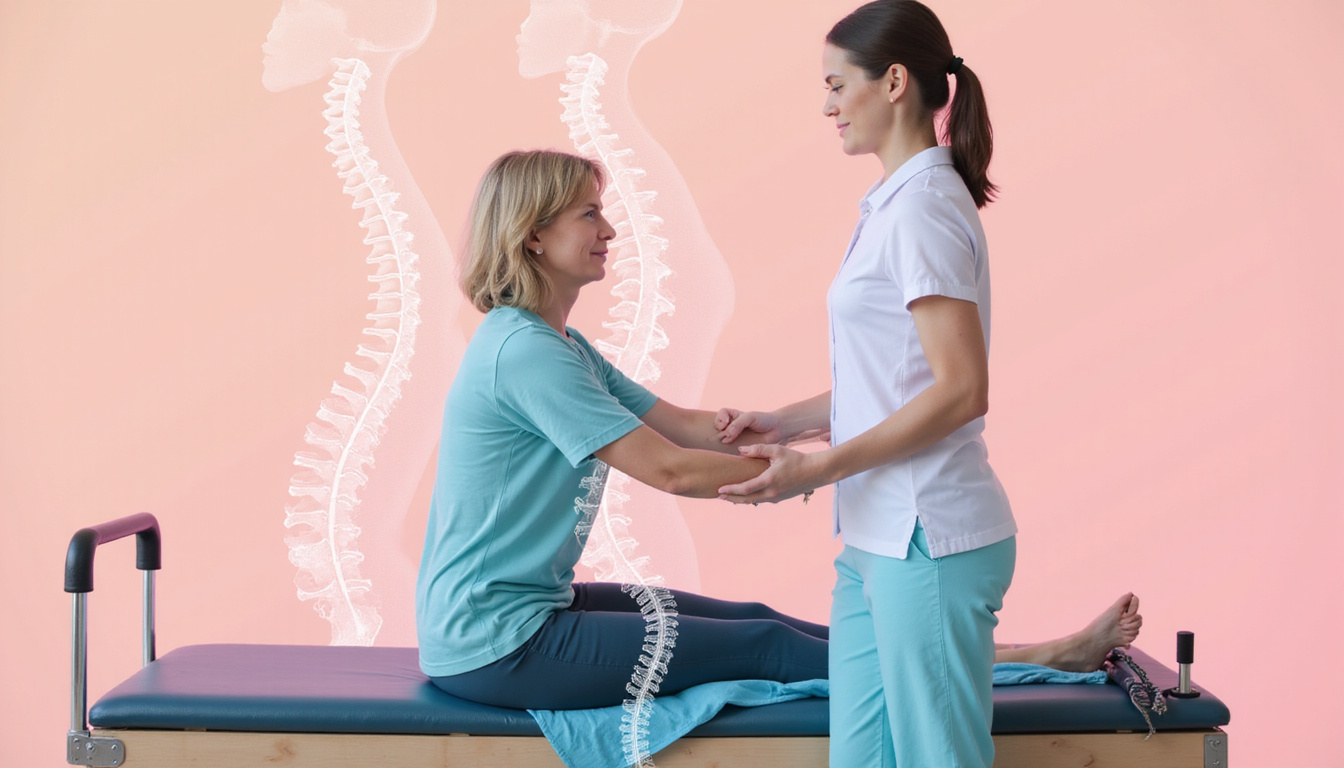
Cadillac and tower ideas for back comfort
When chosen with care, tower work can feel great for a sensitive spine.
• Tower prep and roll downs: Use the push-through bar with springs from above. Move in small segments. Stop at any sign of grip tension.
• Leg springs in supine: Keep the range modest. Let pelvic stability lead over fancy moves.
• Cat stretch on the push-through bar: Move your spine like a rolling wave. Begin with the pelvis instead of just rounding the shoulders.
Everyday alignment for Pilates practitioners
Studio work can be precise. Life outside may not be. To ease long-term back pain, mind your daily alignment:
• Sitting: Keep your pelvis elevated, feet grounded, and maintain gentle neutral alignment. Do not slump into a C-curve at your computer.
• Standing: Avoid locking your knees. Stack your ribs over your pelvis. Imagine your sternum lifting while your ribs stay in place.
• Lifting: Use your hips to hinge. Use Pilates squatting methods. Hold the load close. Exhale as you exert effort.
These everyday choices let your Pilates cues—scoop, wrap, lengthen, float, anchor—protect your spine.
Supporting joints and muscles from the inside
Along with smart movement, focus on good nutrition, hydration, sleep, and thoughtful supplements. Dietary supplements do not diagnose or cure disease. Still, active adults choose ingredients that may support joint comfort and muscle function (source: NIH ODS).
When you consider supplements:
• Read labels carefully. Use them as instructed.
• Discuss products with your healthcare provider. This is especially true if you are pregnant, nursing, on medications, or managing health issues.
• Understand that each person may respond differently.
Many Pilates professionals choose joint-focused nutrients, antioxidants, and supportive botanicals. These fit into a broader self-care routine.
Simple self-check: is this exercise helping or irritating?
Use this checklist when you adjust your session:
-
Pain during the move?
• If the pain is sharp, catching, or burning, then stop and modify.
• If you feel a mild effort or a stretch that eases afterward, it is usually fine. -
How is your back 24 hours later?
• If it is better or the same, you are likely fine.
• If it feels worse or stiffer, scale back range, springs, or complexity. -
Do you see compensation patterns?
• Neck tensing during ab work.
• Glutes not working while the low back compensates.
• Holding your breath to push through the move.
If you spot these signs, simplify. Pilates works best with precise, measured moves—not heroics.
Quick reference: better choices when your back is cranky
• Instead of a full Roll Up, try a Half Roll Back with support.
• Instead of a deep Teaser, try a Supported tabletop with a small chest lift or no flexion.
• Instead of a big Swan, try a small extension that emphasizes length, or prone arm slides.
• Instead of heavy loaded flexion or twisting, try a gentle rotation in neutral or knees-to-side.
Helpful cues include:
• “Grow long before you move.”
• “Float, don’t shove.”
• “Stabilize the pelvis; let the legs do the work.”
• “Breathe wide and deep—not just into your belly.”
FAQ: Pilates back pain and gentle recovery
Q1. Is Pilates good for back pain?
Pilates helps many people with general back discomfort. It improves deep core control, alignment, and movement sense. However, sometimes Pilates back pain appears when exercise is too advanced, too early, or done when fatigued. Work with a qualified instructor, stay within pain-free limits, and consult a professional for personal advice.
Q2. Which Pilates exercises best relieve lower back pain?
Gentle options such as pelvic clocks, supported marching, mini bridges, cat stretch, and neutral-based footwork often feel good on lower-back discomfort. Avoid forcing a Roll Up, deep flexion, or strong extension until you feel secure.
Q3. Can Pilates cause back pain if done wrong?
Yes. Poor technique, working at an unsuitable level, or ignoring pain signals can lead to back pain. Overusing superficial abs, relying too much on back extensors during Swan or Long Box, or slumping into a C-curve under load are common issues. Focus on alignment, breath, and control. If in doubt, step back and refine your technique.
For more detailed advice on joint and muscle health, watch this FAQ video about Regenerix Gold:
https://youtu.be/mGrH5UWFxUs?si=X9bScbG6dvejGkZf
Why savvy Pilates practitioners are choosing Regenerix Gold
If you practice seriously, you invest in studio memberships, quality instruction, and sometimes home equipment. Many dedicated practitioners support healthy joints and muscles with good nutrition. This helps you keep showing up on the mat and Reformer with confidence.
Regenerix Gold is a dietary supplement for adults who want to care for comfortable joints and support muscle function. It does not diagnose, treat, cure, or prevent disease. Yet it may be a smart part of a routine that includes:
• Intelligent, spine-friendly Pilates programming,
• Thoughtful recovery days and good sleep habits,
• Balanced nutrition and hydration.
As a Pilates practitioner in America, you know that waiting too long can cause high costs—more time off work, bigger medical bills, and losing connection with the studio community. Supporting your joints and muscles now helps protect your long-term ability to teach, perform, or simply enjoy your own practice.
If you value being ahead—financially, physically, and professionally—discuss Regenerix Gold with your healthcare provider. It offers a careful choice for those who want their spine, hips, and shoulders to keep pace with ambition and who wish to live an active life without fear of a flare-up.
https://youtu.be/mGrH5UWFxUs?si=X9bScbG6dvejGkZf
Health Note
Always consult a licensed medical doctor for your health issues.
Special Discount
If you prefer preventive nutrition to minimize expensive knee surgery and potentially addictive pharmaceuticals, Regenerix Gold is your savvy solution.
You qualify for a special discount.
Simply use the link below and a discount will automatically be applied during checkout.
Get Regenerix Gold => HERE


