
Pilates mobility Hacks to Improve Posture, Flexibility, and Core Strength
由 Zestora 上 Jan 03, 2026

Pilates mobility means more than merely touching your toes. It is not about fancy teaser variations. It is about joints that move well. It is about myofascial lines that stay long and strong. These lines support your daily movement. They support more than your mat or reformer work.
If your hips grip during footwork, if your shoulders hike in planks, or if your low back pushes back in short spine, then you must treat mobility seriously. Treat it just as you treat your powerhouse.
This guide speaks to Pilates practitioners in America. It reaches those feeling tight, achy, or restricted. It serves those who want to move with ease, flow, and control.
What “Pilates Mobility” Really Means
In Pilates, we mention length, we mention articulation, and we mention control. Yet mobility stays quiet. Mobility is the power to glide through full movements. It pairs stability with precision and with breath-led control. It is not just about stretching farther.
Consider it this way:
• Joints must move freely. They should not pinch or grind.
• Muscles and fascia must react and rebound. They should not feel like rope.
• Your core must support every spine move, from cat stretch to snake and twist.
When your Pilates mobility works well, you notice many changes:
• Your hip flexors grip less during tabletop and hundreds.
• Your roll-downs become smoother, without clunking segments.
• Your overhead arm work eases without rib flare or neck tension.
• Your springs gain power and elasticity with less strain afterward.
Why Mobility Matters for Posture, Flexibility, and Core Strength
Pilates is known for posture and core power. But a stiff body cheats.
• Posture suffers when hip flexors tighten and the thoracic spine locks. This creates that classic “desk slouch.” Neutral spine and tall kneeling fade away.
• Flexibility fails if your hamstrings and calves act like steel cords. Then your low back takes over during roll-ups and spine stretch forward.
• Core strength is lost when joints do not move well. The core cannot organize proper movement, so superficial muscles take over. This leads to tension instead of strong support.
Improved Pilates mobility lets your deep abdominal sling, backline, and glutes do their work. They move cleaner and reduce long-term wear.
Hack #1: Breath-Led Mobility for Better Alignment
Experienced practitioners know that breath is the original Pilates hack. Yet it remains underused for mobility work.
Try this pre-session breathing reset (2–3 minutes):
- Lie in constructive rest. Form a comfortable position with bent knees, flat feet, and a neutral pelvis.
- Place your hands on your lower ribs. Keep your elbows soft.
- Inhale through your nose. Let the ribs widen like an accordion into your back and sides.
- Exhale slowly through pursed lips. Let your ribs knit gently downward. Let your pelvic floor float upward.
- With every exhale, imagine space between your vertebrae. Feel softness around your hips and shoulders.
This simple breathing exercise helps in many ways:
• It lowers tension in your neck and shoulders.
• It frees your ribcage for more thoracic mobility.
• It awakens deep core support before you engage your spring.
Try it before mat or reformer work. Notice how roll-downs, swan prep, and every spine move feel more fluid.
Hack #2: Thoracic Spine Mobility for Effortless Upright Posture
If you notice your head thrusting forward in chest lifts, your shoulder blocks carrying all load in long stretch, or stiffness in swan or with pulling straps, your thoracic spine may be lagging.
Here is a method:
• Place a long foam roller across your mid-back, around bra line level.
• Rest your head on your hands. Keep elbows in soft peripheral view.
• Keep your feet flat. Bend your knees. Keep your pelvis neutral.
• Inhale and extend gently over the roller. Let your ribs stay heavy while your abs engage.
• Exhale and return to a near-neutral position, without crunching forward.
• Shift the roller up a vertebra or two and repeat.
Do 8–10 slow repetitions before short box, swan, or any upper back routine. This primes your thoracic spine, so you avoid hinging from the low back or neck.
Hack #3: Hip Mobility for Stronger, Cleaner Leg Work
Tight hips are a classic Pilates complaint. They cause gripping in single-leg stretch, clicking in leg circles, or cramping in shoulder bridge. True hip mobility means the femur glides in its socket while the core stabilizes the pelvis.
Try the 90/90 Hip Transitions:
- Sit on the mat with legs in a 90/90 angle.
• Your front leg bends at 90° in front of you.
• Your back leg bends at 90° behind you. - Sit tall on your sit bones. If you feel unstable, use a pad or yoga block.
- Inhale to prepare. On exhale, rotate from your hips. Switch the knees across to the opposite side while keeping your spine tall and your pelvis level.
- Move slowly. Do not allow flopping.
Perform 8–12 repetitions. Focus on smooth internal and external rotation. Use this before leg circles, sidelying leg series, or standing splits. It reduces pinching and supports better control.
Hack #4: Hamstring and Calf Mobility Without Overstretching
Many Pilates practitioners chase hamstring flexibility. They often end up with a cranky low back or irritated tendons from overstretching.
Instead of passive hanging stretches, use active lengthening. Try Active Hamstring Scoops:
- Sit tall. Extend one leg long. Bend the other. Position the bent foot against your inner thigh.
- Flex your extended foot. Keep the heel grounded and let the toes point to the ceiling.
- Place your hands next to your extended leg.
- Inhale; then exhale as you hinge from your hip. Reach your sternum toward your toes. Keep your spine long.
- On the return, press the extended heel gently into the floor. Picture dragging it toward you to wake up the backline.
This move builds both mobility and strength. It supports cleaner roll-ups, spine stretch, and long spine work on the reformer without causing strain.
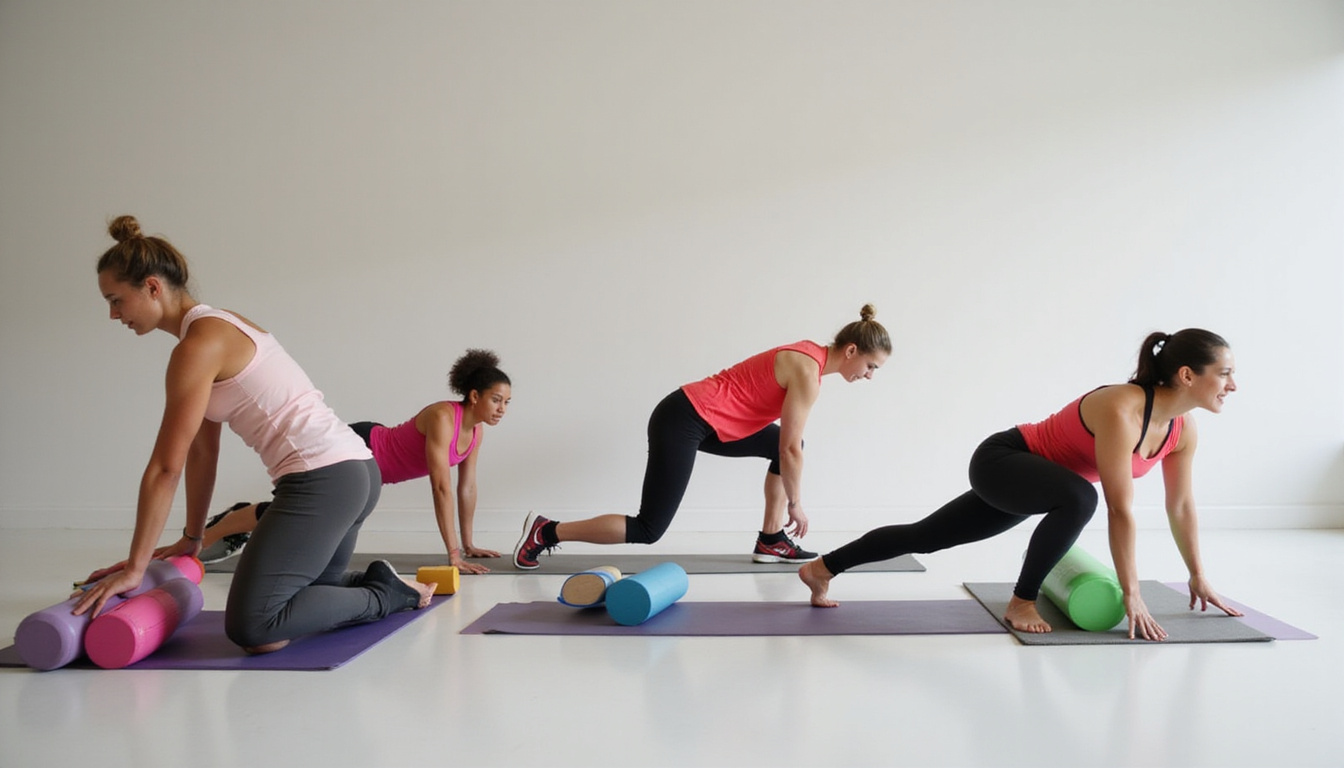
Hack #5: Shoulder and Scapular Mobility for Pain-Free Upper Body Work
If your neck and upper traps work too hard during rowing, long stretch, or overhead moves, your scapulae may not glide well.
Use Wall Scap Slides:
- Stand with your back close to a wall. Step your feet about 6–8 inches forward. Keep your pelvis and ribs neutral.
- Place your forearms and the backs of your hands against the wall. Keep your elbows at about 90°.
- Inhale. Slide your arms upward against the wall. Keep full contact and avoid rib flare.
- Exhale. Slide your arms back down slowly. Feel your shoulder blades glide easily over your rib cage.
Do 10–12 slow repetitions. This helps your scapulae move well and support your planks, long stretch, and arm circles. It lessens neck effort.
Hack #6: Core-Integrated Mobility Flows
Static stretches have their place. Pilates mobility shines when it flows. Instead of adding static stretches at the end, build core-integrated mobility flows into your warm-up.
Consider this short flow:
- Cat-cow with focused breathing
- Thread-the-needle thoracic rotations
- Lunge with overhead reach and side bend
- Roll-down to forward fold and slow roll-up
This sequence does three things:
• It warms your joints as you move through full ranges.
• It connects mobility work with your powerhouse.
• It sets a neuromuscular template for your session.
Use this flow before heavier series like short spine, long stretch, or star. It helps you move cleanly and in control.
A Simple Pilates Mobility Warm-Up You Can Use Daily
Here is an 8–10 minute all-around warm-up. It is made for Pilates practitioners with tight or uncomfortable joints:
- Breath and rib expansion: Do 6–8 cycles in constructive rest.
- Cat-cow: Perform 8 slow repetitions, thinking about each segment.
- 90/90 Hip Transitions: Do 8–12 controlled switches.
- Foam Roller Thoracic Extensions: Complete 8–10 gentle repetitions.
- Active Hamstring Scoops (each side): Do 6–8 repetitions.
- Wall Scap Slides: Do 10–12 repetitions.
This warm-up changes how your joints feel. It helps your core fire efficiently for your session.
Where Smart Supplementation Fits In
When you increase your Pilates mobility, you ask more from your joints, muscles, and connective tissues. A smart lifestyle builds on consistent practice, good sleep, and proper nutrition. Some practitioners add dietary supplements to support joint comfort and muscle function.
In the U.S., dietary supplements are regulated as foods. They do not diagnose, treat, cure, or prevent diseases. Supplements for joint and muscle support are chosen to help:
• Lubricate joints and support cartilage health.
• Keep load-bearing joints comfortable during daily use.
• Supply nutrients for normal muscle recovery and function.
Before you use a supplement, check that it:
• Comes from facilities that follow current Good Manufacturing Practices (cGMP).
• Lists ingredients and serving sizes clearly.
• Does not make drug-like claims.
The National Institutes of Health offers guidance on evaluating supplements and understanding labels. Visit their site (NIH Office of Dietary Supplements) for more details.
Speak with your healthcare provider before starting any new supplement. This is especially important if you are pregnant, nursing, taking medications, or managing any health condition.
Regenerix Gold for Pilates Practitioners Who Take Mobility Seriously
Many dedicated practitioners choose Regenerix Gold as part of a joint and muscle–friendly lifestyle. Regular use of reformer, chair, Cadillac, and advanced mat work calls for support. This supplement is used to:
• Enhance comfortable, fluid joint movement during bending, twisting, and weight-bearing.
• Complement a mobility-focused routine so you can roll up, extend, and rotate with ease.
• Help you stay consistent with your practice when joints or muscles feel overworked.
For practitioners in America, avoiding expensive medical care and lost workdays matters. Protecting joint comfort and physical capacity is not just about feeling good. It is about keeping long-term independence, productivity, and career options. Staying strong, mobile, and resilient helps you teach, perform, and progress in your work without body worries.
Pilates people are body-aware and research-driven. Adding a joint and muscle support formula like Regenerix Gold to your Pilates routine can keep you one step ahead. You choose proactive self-care rather than letting discomfort rule your schedule.
If you invest wisely in your body, discussing Regenerix Gold with your healthcare provider may help you protect against missed opportunities, lost time, or steep healthcare costs.
Regenerix Gold
FAQ: Pilates Mobility and Joint-Friendly Practice
Q1: How can Pilates mobility exercises help with everyday stiffness?
Pilates mobility exercises work to let your joints move fully and in control. Your core then supports each motion. Over time, this practice makes sitting, standing, or lifting feel less stiff. Your daily patterns mirror the clean moves from your mat work.
Q2: How often should I do a Pilates mobility routine to support my joints and muscles?
Most practitioners find that 3–5 dedicated mini-sessions per week work best. Even 10–15 minutes often helps. Consistency beats intensity. Daily practice leads to more comfort than an aggressive, infrequent routine.
Q3: Can Pilates mobility work and a joint support supplement be used together?
Yes. Many blend a solid Pilates mobility program with good nutrition, hydration, and joint support supplements when needed. Regenerix Gold, for example, is meant to add to — not replace — movement, recovery, or professional advice. Always check with your healthcare provider before you add a new supplement.
Health Note
Always consult a licensed medical doctor for your health issues.
Special Discount
If you prefer preventive nutrition to minimize expensive knee surgery and potentially addictive pharmaceuticals, Regenerix Gold is your savvy solution.
You qualify for a special discount.
Simply use the link below and a discount will automatically be applied during checkout.
Get Regenerix Gold => HERE


