

For many of us, the practice lets us breathe through discomfort, face our limits, and find ease in our bodies. When joints hurt or feel stiff, yoga for arthritis shifts focus. It becomes less about nailing inversions and more about simple joys—stepping off the mat without pain, taking the stairs, or sitting cross-legged with a soft, open back. If you practice yoga in the U.S. and experience joint stiffness or pain, you can continue on your path. Use smart modifications, joint-friendly moves, and mindful support for each tissue.
Below is a people-first, practice-centered guide to keeping your flow alive when joints ask for more care than intensity.
Why Yoga for Arthritis-Style Pain Is Different
When we say “yoga for arthritis” here, we mean yoga for creaky, stiff, or sore joints. You may not have a formal diagnosis, yet you still adjust your practice. Many practitioners change their routine over the years, unknowingly using gentle, joint-supportive yoga.
Common realities for practitioners with joint sensitivity:
- Knees feel vulnerable in deep flexion (malasana, hero’s pose, kneeling moves).
- Wrists hurt in long planks, chaturangas, or arm balances.
- Hips feel “rusty” after sitting. This makes lotus, half-lotus, and deep external rotations feel risky.
- Shoulders resist full overhead movement or weight-bearing in down dog and inversions.
The goal is not to push through the pain. The goal is to:
- Maintain or gently increase a pain-free range of motion.
- Strengthen muscles around joints for better support.
- Use breath and calmness to reduce tension.
Evidence suggests that mind–body practices, like yoga, can support joint comfort, mobility, and quality of life when done consistently and gently (source: NIH).
Principles of a Joint-Smart Practice
Before adopting specific poses, keep these guiding principles in mind:
-
Prioritize sensation over shape.
Do not chase the “Instagram pose.” Stop at mild to moderate stretch, not sharp or pinching pain. -
Support then explore.
Use blocks, bolsters, straps, blankets, or chairs. This is not cheating; it is smart self-care. -
Take slow transitions.
Move slowly when shifting from standing to the floor or kneeling. Think “tai chi” pace, not “HIIT vinyasa.” -
Respect fatigue.
Your stabilizing muscles tire quickly. When they do, your form may suffer. Take child’s pose or rest when needed. -
Work around, not against, pain.
If a movement raises your pain, adjust its angle, lessen the load, or swap it for a gentler choice.
Gentle Standing Poses for Sturdy, Supported Joints
Standing asanas work well for many with joint sensitivity if you lower the drama and raise the alignment.
1. Mountain Pose (Tadasana) with Microbends
Tadasana resets alignment for your joints.
- Stand with feet about hip-width apart or at a distance that feels right.
- Keep a slight bend in your knees; do not lock them.
- Draw energy up from the earth through your ankles, shins, and thighs.
- Firm your thighs and lift your belly slightly, without gripping.
- Open your collarbones, soften your shoulders, and lengthen the back of your neck.
Notice how stacking your joints properly makes each connection strong: ankles under knees, knees under hips, hips under shoulders.
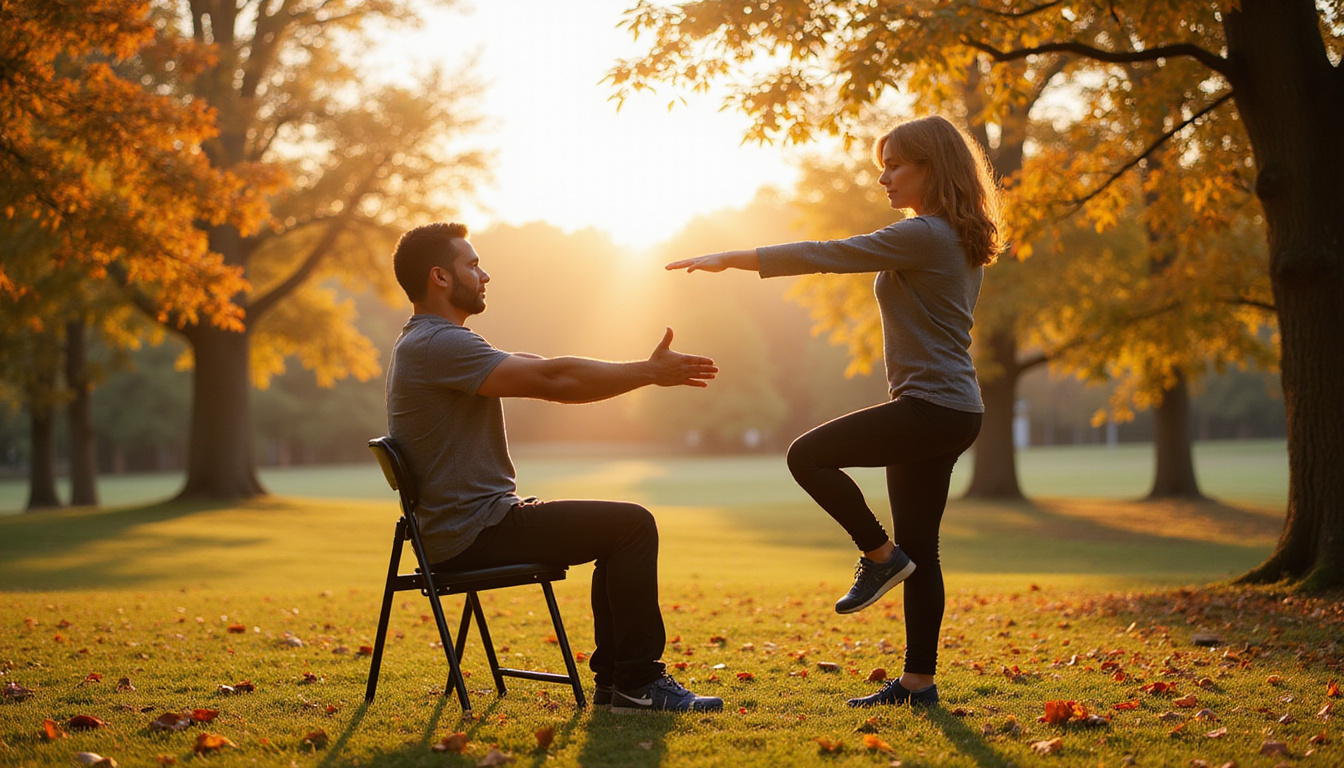
2. Chair-Supported Warrior II (Virabhadrasana II)
Warrior II improves hip mobility and leg strength. Still, it can load the knees too much.
- Place a chair behind you along the mat’s long edge.
- Sit sideways on the chair. Extend one leg forward with the foot turned slightly in; bend the other knee, letting the foot point forward.
- Open your arms wide and gaze softly over the front fingers.
- Keep the front knee over the middle toes and do not let it collapse inward.
This version gives you warrior energy and hip opening while sparing the knees.
3. Supported Triangle (Trikonasana) with Block
- Step your feet wide, but not so wide as to strain.
- Turn your front toes forward and your back toes slightly inward.
- Place a block outside your front shin at a height that stops any painful hinge.
- Slide your front hand down to the block, keeping shoulders stacked if you can.
Focus on lengthening both sides of your waist evenly. This lessens compression on the spine and reduces hip irritation.
Floor Poses to Gently Open Hips and Ease the Low Back
Floor work shines in yoga for arthritis. Here, gravity is milder, and you can hold poses longer without extra weight.
4. Reclined Bound Angle (Supta Baddha Konasana) with Props
- Lie on your back with knees bent and soles of the feet touching.
- Place blocks or folded blankets under your outer thighs so the legs are fully supported.
- Optionally, rest a bolster along your spine for a gentle heart opener.
This pose softly opens the groins and hips without forcing deep rotation. Check if your inner knees or hips feel strained; adjust support as needed.
5. Supine Hamstring Stretch with Strap
Tight hamstrings tug on your pelvis, which can affect the low back, hips, and knees.
- Lie on your back and loop a strap around the ball of one foot.
- Gently extend the leg toward the ceiling while keeping the other leg bent or straight on the mat.
- Keep a slight bend in the lifted knee. There is no need for a power yoga straight-leg stretch.
Aim for a comfortable, open stretch along the back of the thigh, not a fierce pull.
6. Supported Bridge (Setu Bandha Sarvangasana)
- Lie on your back with knees bent and feet hip-width apart.
- Press your feet into the mat and lift your hips a few inches.
- Slide a block of low or mid height under your sacrum. Let your pelvis rest on the block.
This pose opens the front body and gently strengthens your glutes and hamstrings. It also gives your spine and hips a light decompression.
Wrist- and Shoulder-Friendly Upper Body Work
If down dog or plank feels like war between your wrists and the mat, try these alternatives:
7. Puppy Pose at the Wall
- Stand facing a wall. Place your forearms on the wall at shoulder height.
- Walk your feet back and hinge at the hips until your torso is roughly parallel to the floor. Keep your hips aligned over your ankles.
- Let your chest soften toward the floor while keeping the neck neutral.
This version opens the shoulders like puppy pose but spares sensitive wrists.
8. Tabletop with Fists or Forearms
If your wrists hurt in tabletop:
- In tabletop position, make gentle fists and place the knuckles down. Keep the wrists neutral.
- Or lower onto your forearms for a cat–cow flow. This reduces wrist extension.
Make sure your shoulders remain broad and do not collapse downward.
A Short, Gentle “Yoga for Arthritis” Sample Sequence
Here is a 15–20 minute practice to adapt on days when your joints feel tender but you still want to move and breathe.
-
Constructive Rest (3–5 minutes)
Lie on your back with knees bent and feet on the mat. Place your hands on your belly and breathe slowly through your sides and back ribs. -
Supine Hamstring Stretch (1–2 minutes each side)
Use a strap and keep the stretch comfortable and easy to breathe in. -
Supported Bridge (2–3 minutes)
With a block under your sacrum, let your arms rest by your sides. -
Reclined Bound Angle (3–5 minutes)
Support your knees and thighs fully with props. -
Supported Tabletop Cat–Cow (2–3 minutes)
On your fists or forearms, gently move your spine in a soft wave. -
Chair-Supported Warrior II (1–2 minutes each side)
Breathe slowly. Let your knee ease into the bend; do not force it. -
Wall Puppy Pose (2–3 minutes)
Let your chest soften to the floor with ease. -
Seated Forward Fold on Chair (3–5 minutes)
Sit on the edge of a chair with feet flat. Hinge from your hips with a long spine. Rest your forearms on your thighs or a bolster on your lap.
Always exit each pose slowly. Pause if your joints feel surprised by the movement.
Smart Props and Modifications Every Joint-Savvy Yogi Should Consider
If you shift from power flows to a joint-friendly practice, you may benefit from these tools:
- Two sturdy blocks to raise the floor for forward folds, lunges, and standing poses.
- A thick, supportive mat that cushions your knees, hips, and wrists.
- A folded blanket or towel to put under knees or ankles in kneeling or seated poses.
- A strap to bridge the gap between your hands and feet when mobility is low.
- A yoga chair for supported standing work, safe backbends, and smooth transitions.
These props are not training wheels. They help you load your joints in a way that builds strength rather than irritation.
How a Supplement Strategy Fits Into a Joint-Smart Yoga Lifestyle
As a yoga practitioner in America, you likely think holistically. Asana, breath, food, sleep, stress, and environment all work together. Some include high-quality supplements to support joint and muscle health.
Within FDA guidelines, note that:
- Supplements cannot claim to diagnose, treat, cure, or prevent any disease.
- They can support the normal structure and function of joints, cartilage, and muscles. They may also help maintain comfortable movement and flexibility.
If you face recurring stiffness or discomfort after your practice, you might explore a daily joint health supplement. Use it along with your mat roll-out, hydration, and recovery. Look for products that:
- Are made in facilities that meet good quality standards.
- Clearly list ingredients and amounts.
- Avoid exaggerated promises of a cure.
For those who view yoga for arthritis-style practice as long-term self-care, smart supplementation becomes an extra layer of support for cartilage, connective tissues, and recovery—especially when combined with mindful loading and rest days.
Video: Regenerix Gold
Regenerix Gold
FAQ: Yoga for Joint Pain and Stiffness
Q1: Is yoga good for arthritis and joint stiffness?
Yoga can gently support joint comfort, mobility, and strength when you work mindfully and adapt to your body. Slow movements, proper alignment, and breath are key. Always listen to pain signals and check with a health professional if you are unsure.
Q2: What are the best yoga poses for arthritic knees and hips?
Many find relief in chair-supported warriors, standing poses with smaller stances, supine hamstring stretches, supported bridge, and reclined bound angle. Use props to reduce load and control the depth of hip openers. This makes yoga for arthritis a sustainable practice.
Q3: Can I keep doing vinyasa if I use arthritis-style modifications?
Yes, but you may need to change parts of your flow. Swap full chaturanga for a knees-down version, down dog for wall puppy, and high lunges for supported or chair-based lunges. This modified yoga routine for arthritis can still flow like a vinyasa while protecting your joints.
Reclaiming Your Edge: Why Regenerix Gold Fits the Serious Yogi’s Toolkit
If you have read this far, you are not a casual once-a-month studio visitor. You know that staying on your mat, comfortably and confidently, for years is a strategy. Smart sequencing, props, recovery, nutrition, and the right supplements all add up.
Regenerix Gold supports healthy joints and muscles so you can keep doing what you love. For dedicated yoga practitioners in America, that means:
- Continuing to teach or practice without worrying that every move will cost your knees or shoulders later.
- Investing now in joint and muscle support instead of facing future medical costs or lost work because you could not move as needed.
- Enjoying the confidence that comes from taking steps that many do not—steps that favor mobility, resilience, and stability.
If your body is your instrument—whether you are demonstrating poses, deepening your practice, or simply moving through life with ease—consider adding Regenerix Gold to your daily routine along with your yoga for arthritis practice. It is a choice for those who do not want to feel just “okay” but optimally supported. Long-term freedom of movement is one of the smartest investments you can make.
Health Note
Always consult a licensed medical doctor for your health issues.
Special Discount
If you prefer preventive nutrition to minimize expensive knee surgery and potentially addictive pharmaceuticals, Regenerix Gold is your savvy solution.
You qualify for a special discount.
Simply use the link below and a discount will automatically be applied during checkout.
Get Regenerix Gold => HERE


