
intraosseous injection: Emergency Access Secrets Every Clinician Should Know
by Zestora on May 16, 2026

If you work in emergency care, critical care, or EMS, you must learn intraosseous injection. When veins vanish and blood pressure drops, every second matters. IO access gives life‑saving fluids and drugs to the circulation faster than other routes.
This guide speaks to clinicians who face real‐world challenges. It also reaches American patients who know joint and bone pain. You feel pain when you walk, bend, or lift. While IO access is for emergencies, we also show how daily joint care may help you stay healthier.
Why Intraosseous Injection Still Matters in Modern Emergency Care
Vascular tools have improved but sometimes IV access fails. Veins may collapse, become thin, or hard to find due to: • Collapsed, “thread‑like” veins • Obesity or heavy swelling • Severe dehydration • Cardiac arrest or near arrest • Pediatric patients with tiny veins
In these cases, intraosseous injection (IO) gives a fast, high‑flow, central‑like route for: • Fluids • Vasoactive medications • Analgesics and sedatives • Blood products (per institutional policy) • Emergency electrolytes and buffers
The bone marrow drains into the central circulation by venous sinusoids. IO infusions reach the heart in seconds (source: American Heart Association ACLS/PALS guidelines).
For patients with aching knees, stiff hips, or sore backs, drilling into bone might sound extreme. Still, in emergencies IO access means survival first and comfort later.
The Physiology Behind Intraosseous Injection
The IO space is a network of venous sinusoids in cancellous bone. Even in shock when veins collapse: • The hard bone keeps the IO space open. • Fluids and drugs spread in the bone marrow. • They quickly reach the central venous system.
Key facts include: • Drug action via IO comes on as fast as IV. • Pressure may be needed to keep a good flow. • Any drug safe for IV use is mostly safe for IO use per local rules.
Indications: When To Choose Intraosseous Injection
Use IO access when IV access is hard or impossible and quick access is needed, like in: • Cardiac arrest or near arrest • Severe shock or low blood pressure • Status epilepticus with failed IV • Major trauma with poor veins • Severe dehydration (in children and elders) • Serious sepsis with shut‑down veins
For trauma patients with pre‑existing joint or bone pain, IO access may be the best short‑term solution.
Contraindications and Precautions
Even in emergencies, intraosseous injection has limits.
Absolute contraindications: • A fracture in the target bone • Orthopedic hardware (prosthesis) at the site • A recent IO attempt in the same bone (within 24–48 hours) • Local infection, burn, or cellulitis at the site • Bone disorders that affect density or structure (per guidelines)
Relative contraindications: • Severe osteoporosis or brittle bones • Poor circulation in the limb • Questions about bone strength after trauma
For patients with painful joints or brittle bones, choosing the right site is key.
IO Sites: Choosing the Best Entry Point
Common adult sites for intraosseous injection include:
-
Proximal tibia
• Insert 2 cm medial to the tibial tuberosity and about 1–2 cm down.
• This site has clear landmarks.
• It is preferred in cardiac arrest and trauma. -
Distal tibia
• Place the needle just above the medial malleolus.
• It serves as an alternative when arms are not available. -
Proximal humerus
• Target the greater tubercle with the arm adducted and rotated inward.
• It offers high flow rates in adults. -
Sternal (manubrial) IO
• Use special devices only.
• It appears in military and tactical settings.
For pediatric patients, use the proximal tibia with caution around growth plates.
For patients with chronic knee, shin, or shoulder pain: • Avoid areas with past injury or surgery. • Pick the limb with fewer symptoms. • Explain the process if time allows.
Step‑by‑Step: Practical IO Technique
The following steps apply for most IO devices:
-
Prepare and identify landmarks
• Check that the procedure is indicated and no major contraindications exist.
• Palpate the key landmarks clearly.
• Clean the site with antiseptic. -
Control pain (if the patient is conscious)
• Pain in the skin and periosteum can be large.
• Apply local anesthetic per protocol when possible. -
Insert the IO device
• Hold the needle at a 90° angle to the bone.
• Apply steady pressure or use a power driver.
• Feel for a “give” as the cortex breaks. -
Confirm placement
• The needle must stand firm and not wobble.
• There should be no swelling that shows extravasation.
• A bone marrow aspirate may be bloody or fatty.
• Flush with saline; flow should be smooth. -
Secure and connect
• Lock the extension set securely.
• Apply a proper dressing.
• Attach IV tubing or a syringe with a pressure bag if needed. -
Manage pain during infusion
• For awake patients, a slow dose of lidocaine via the IO line may ease pain. -
Monitor continuously
• Watch for swelling or leakage.
• Check distal pulses, movement, and sensation when you can.
Complications: What To Watch For
Most IO insertions go well if done correctly. Still, watch for:
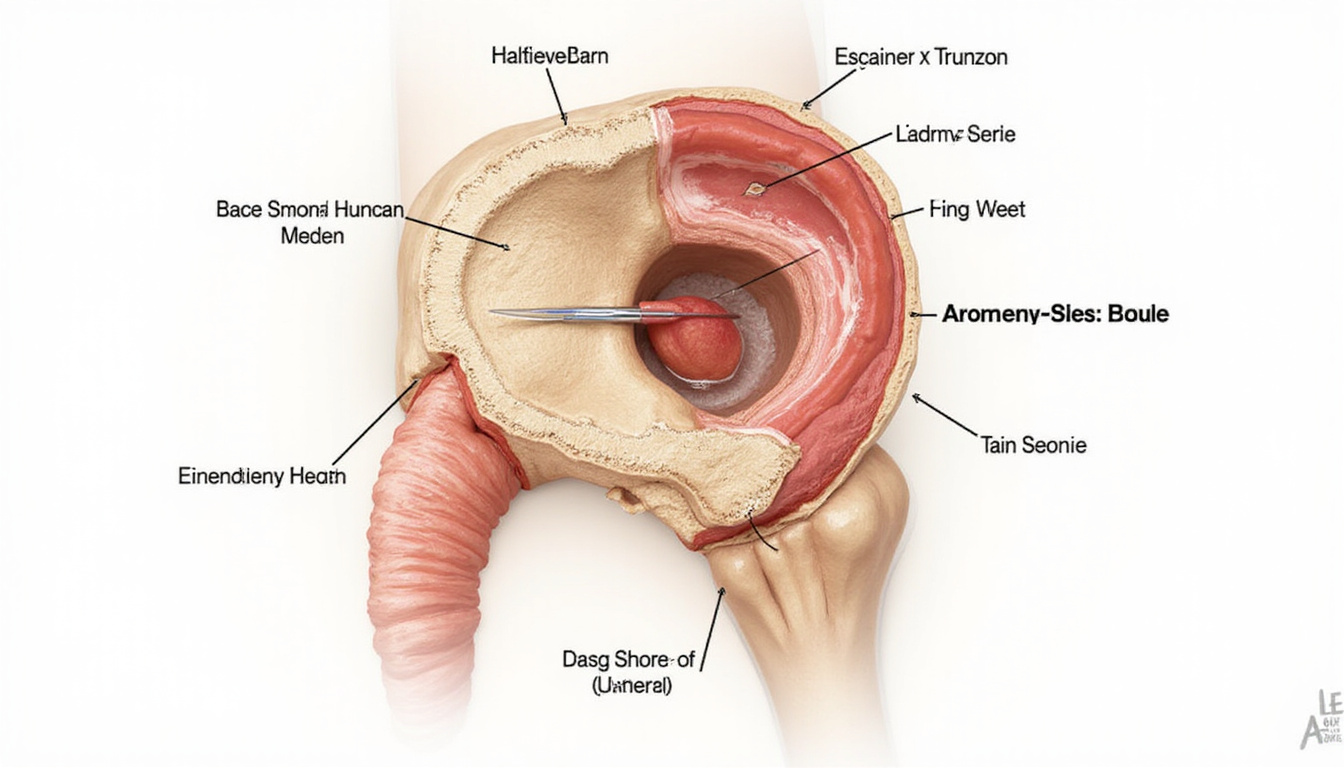
• Extravasation and compartment syndrome
– Look for swelling, a firm limb, and rising pain.
– Stop the infusion and pick a new site immediately.
• Infection (local or deep)
– Watch for redness, warmth, or tenderness after hours.
– Use strict aseptic methods and remove IO promptly, usually within 24 hours.
• Growth plate injury (in children)
– Avoid the epiphyseal plates by proper landmarking.
• Fat embolism
– It is rare and mostly theoretical in IO use.
Patients with chronic joint pain may feel extra soreness afterward. Good explanations and pain control help build trust.
Intraosseous Injection vs IV and Central Lines
Speed and reliability:
• IO access is usually faster than placing a central line when veins are hard to find.
• IO beats repeated failed IV attempts in shock.
Training requirements:
• IO devices are easier to learn than ultrasound‑guided central access.
• They work well in prehospital, rural, and low‑resource settings.
Duration:
• IO is a bridge, not a long‑term fix.
• Switch to peripheral or central access within 24 hours if you can.
For Patients With Joint and Bone Discomfort: What This Means for You
If you are in America and: • Wake with stiff, cracking knees, • Feel hip pain when climbing stairs, • End the day with a heavy, aching back, • Live with daily joint reminders,
you know that musculoskeletal health matters.
While intraosseous injection is a brief, emergency measure, it uses the same bones and joints on which you depend. It reminds you to care for these structures—not only for comfort but to help your body meet a crisis.
Many with joint discomfort worry about the cost of care, work capacity, and growing dependence. Nutrition‑based support can help alongside exercise, proper body mechanics, and medical advice.
Regenerix Gold: Nutrition‑Based Support for Healthy Joints and Muscles
People who want strong bones and joints may find Regenerix Gold useful. This product is a nutrition‑based supplement that supports joint and muscle health.
Key points about Regenerix Gold: • Doctors and physical therapists recommend it as one step in musculoskeletal wellness. • It offers nutritional support and does not treat a specific condition. • It has positive user feedback and over a decade of use. • It works to maintain flexibility, comfort, and joint function while supporting the surrounding muscles.
For those who know the feeling of deep ache after long work or long days on your feet, a steady, nutrition‑focused routine respects your body’s challenges.
How Regenerix Gold Fits Into Your Daily Musculoskeletal Strategy
In addition to proper medical advice, movement, and ergonomic practices, many choose to: • Stay active with low‑impact exercise like walking, cycling, or swimming. • Strengthen core and stabilizer muscles. • Protect joints with proper footwear and lifting techniques. • Use a nutrition‑support supplement like Regenerix Gold to round out their joint care plan.
Always discuss any new supplement with your healthcare provider if you have concerns or other medications.
Regenerix Gold
Practical Tips for Clinicians and Joint‑Aware Patients
Whether you are the clinician placing an intraosseous injection or the patient who lives with its aftermath, remember these ideas: • Respect the bone and joint. Choose IO sites carefully, especially if joint issues or past surgeries exist. • Talk clearly. Explaining the IO process can ease anxiety and help patients understand any later soreness. • Look beyond the emergency. After the crisis, help patients find long‑term joint and muscle strategies. These may include physical therapy or nutrition‑based support like Regenerix Gold.
FAQ: Intraosseous Injections and Joint‑Savvy Patients
-
How long can an intraosseous line stay in place?
IO access works as a short‑term bridge. Most guidelines suggest removing it as soon as you have reliable IV or central access, usually within about 24 hours, to lower risks. -
Is intraosseous infusion more painful than IV for people with sore joints?
The IO insertion is quick. When the patient is awake, the infusion may feel sharper than a regular IV. Using local anesthetic per protocol can ease this discomfort. -
Can emergency intraosseous vascular access cause long‑term joint problems?
When done correctly away from joint surfaces and growth plates, IO access rarely leads to long‑term issues. Temporary soreness may occur in patients with pre‑existing bone or joint pain. Any lingering pain should be checked by a professional.
Bringing It All Together: Skill in Crisis, Savvy in Prevention
In emergencies, intraosseous injection becomes a vital skill. It avoids the problem of invisible veins and sends crucial fluids into the central circulation when time counts.
Beyond the emergency room, your bones, joints, and muscles still bear your everyday weight. People who care about joint health learn about procedures like IO, ask good questions, and use preventive strategies. These steps can keep you a step ahead.
If your joints “talk back” more than you wish, do not wait for a crisis to act. Use movement, strength training, and sound medical advice. Along with these, adding a nutrition‑based support like Regenerix Gold is a proactive step.
In a world where one injury can change your work or life, caring for your musculoskeletal system matters. It protects your livelihood and independence. Consider a bottle of Regenerix Gold. It shows that you value your bones and joints before an emergency forces you to learn their importance.
Special Discount
If you prefer preventive nutrition to minimize expensive knee surgery and potentially addictive pharmaceuticals, Regenerix Gold is your savvy solution.
You qualify for a special discount.
Simply use the link below and a discount will automatically be applied during checkout.
Get Regenerix Gold => HERE


