
pickleball joint friendly drills that relieve pain and boost performance
by Zestora on Mar 29, 2026

If you’ve looked for pickleball drills that are kind to your joints, you are not alone. You play dink battles, kitchen skirmishes, and long rec sessions. Even experienced Picklers feel pain in their knees, hips, shoulders, and elbows. The good news is that smart routines, good nutrition, and proper recovery let you play hard while easing joint stress.
Below is a practical, people-first guide for American Pickleball players. This guide helps you protect your joints, ease daily aches and stiffness, and boost your performance.
Why “joint friendly” matters in pickleball
Pickleball is no longer a slow walk. Fast hands, sudden stops, split-steps, quick lunges, and high overheads load your joints.
The common pain points are:
- Knees that feel stress from quick direction changes and low dinks.
- Hips and lower backs that suffer from staying in a semi-crouched ready position.
- Shoulders that bear strain from serves, overheads, and roll volleys.
- Elbows and wrists that get hurt by repetitive dinks, drives, and spin.
If you warm up with two shadow swings and then hit hard, your joints pay the price. Joint-friendly pickleball drills protect your body while sharpening the moves you need to win rec games and tournaments.
Ground rules for joint friendly pickleball training
Before you dive into drills, remember these simple rules:
- Warm up before you hit hard. Cold joints do not like quick, explosive moves.
- Begin with low-impact moves; save high-intensity actions for later. Build stability first, then speed.
- Feel pain? That is a red flag. Mild effort discomfort is acceptable, but never sharp or lasting pain.
- Support your joints from the inside. Drink water, eat smart, and try supplements like Regenerix Gold. These help your joints handle the game.
Phase 1: Pre-court warm-up – 5–8 minutes of joint friendly mobility
Do these drills in the parking lot or near the fence while waiting.
1. Pickleball shuffle + reach (hips, knees, ankles)
• Begin at the baseline in a ready stance.
• Shuffle to the right for three steps, tap the sideline with your paddle hand, then shuffle left for three steps and tap.
• Keep your hips low but comfortable—avoid deep squats.
• Do 4–6 passes.
This drill uses low-impact side moves. It keeps your knees and ankles lubricated. The movement stays close to real court motion without a full-out sprint.
2. Kitchen line heel raises (ankles, calves, balance)
• Stand on the kitchen line with feet hip-width apart.
• Slowly rise on your toes, pause for 1–2 seconds, then lower with control.
• For more challenge, reach forward with your paddle as you raise.
• Do 2 sets of 10–15 reps.
Stronger calves and ankles help absorb the shock when you split-step or push off fast.
3. Open and close the gate (hips and groin)
• Hold the net post lightly or use your paddle for balance.
• Lift one knee to hip height. Rotate it outward (open the gate) then bring it back (close the gate).
• Do 8–10 reps on each leg.
Loose hips improve your kitchen moves. They also ease knee stress.
4. Paddle circles for shoulders
• Hold your paddle out with a loose grip.
• Draw slow circles with the paddle. First, do circles forward for 20–30 seconds, then backward.
• Keep your shoulders down and relaxed.
This warms your shoulder joints for serves, drives, and volleys without heavy loading.
Phase 2: On-court joint friendly drills for pain relief and performance
These drills use smart work. They create minimal pounding and boost your game.
5. Quarter-court dink box (joint friendly kitchen control)
Set-up:
• Work in one service box. Stand at the kitchen line across from your partner.
• Both players hit only within that service box.
Focus:
• Use small, glide-like steps.
• Stay in a comfortable knee bend; avoid deep lunges.
• Aim to hit 50–100 controlled dinks with soft hands and body control.
Benefits:
• It reinforces low-impact footwork.
• It keeps you balanced without explosive moves that stress the knees and hips.
• It builds touch so you do not over-swing with your shoulder.
6. “Three-step” volley drill (shoulder and elbow friendly hand speed)
Set-up:
• Both players stand at the NVZ line.
• One player feeds a gentle volley. The partner blocks it back.
• After each hit, take three light steps. These can be mini-skips or shuffles.
This drill uses moderate tempo, not full speed.
Benefits:
• It teaches compact strokes. Your shoulder and elbow need not twist excessively.
• It builds a rhythmic pace and hand speed with less strain on your arms.
7. Soft third-shot drop ladder (knee and back friendly mechanics)
Set-up:
• One player stands on the baseline. The partner stands at the kitchen.
• The baseline player works on third-shot drops into three target areas: near, mid, and deep NVZ.
Joint friendly tweaks:
• Use a neutral, athletic stance. Avoid a super-wide base that stresses your hips.
• Use your legs and core; do not rely on an arm flick.
• Keep each rep smooth, at practice pace instead of maximum power.
Reps:
• Hit 10 drops to the near NVZ, 10 to mid, and 10 to deep NVZ.
• Switch roles after finishing.
This drill teaches you an efficient load and smooth follow-through. These reduce lower back and shoulder strain.
8. Shadow split-step + slide (impact control)
You do not need any balls.
• Start in the transition zone.
• Imagine an opponent ready to hit. As they hit, make a soft split-step. Land on both feet at the same time.
• Then slide one or two smooth steps toward an imaginary ball.
• Repeat 8–10 times forward, then 8–10 times side-to-side.
The goal is to have light, springy feet. Land quietly; do not stomp. Keep your knees over your toes.
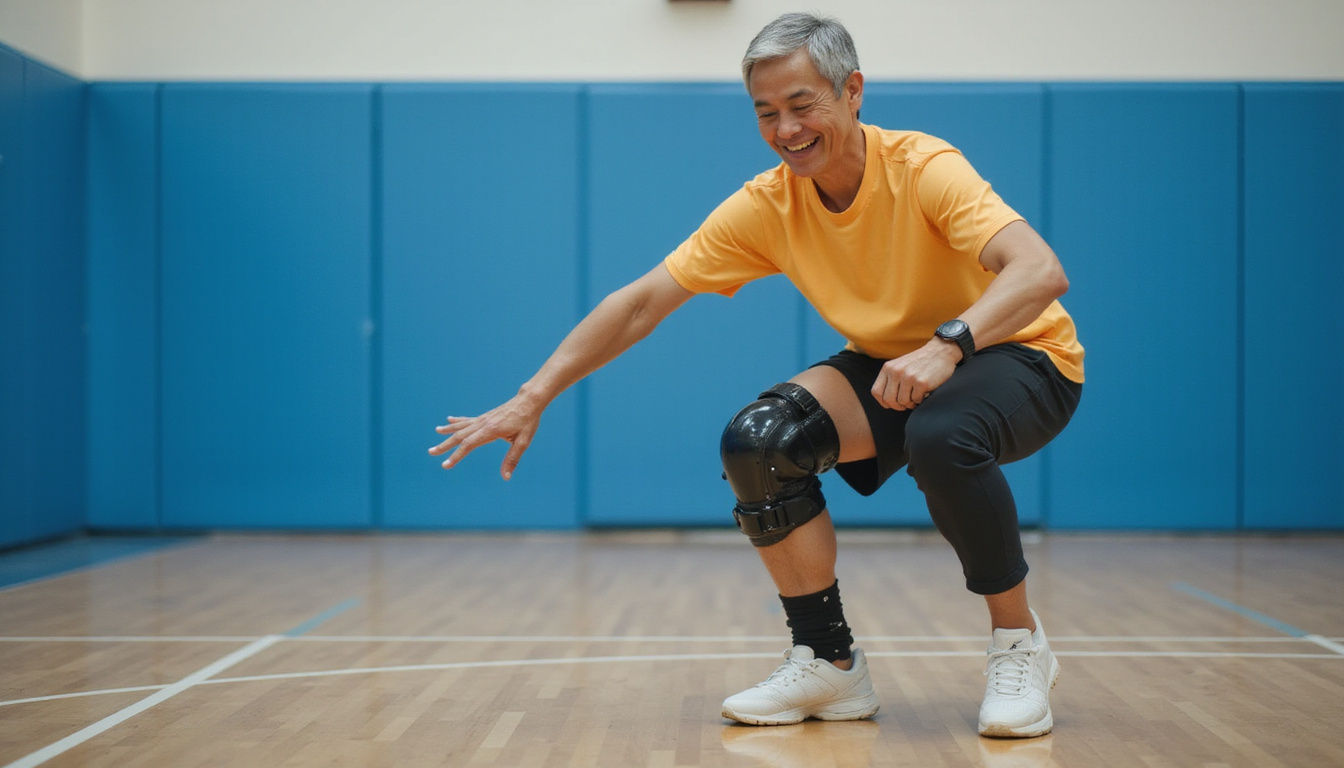
This pattern helps you react safely when a fast drive comes at your feet.
Phase 3: Strength-based joint friendly drills (off-court or side court)
A little strength work goes a long way in joint comfort and stability.
9. Wall sits for Picklers (knees and hips)
• Stand with your back against a wall. Slide down until your knees bend comfortably (do not go past 90 degrees).
• Hold for 15–30 seconds. Rest and repeat 2–3 times.
This low-impact exercise builds strong quads and glutes. These muscles take pressure off your knees while you play.
10. Band pull-aparts with your paddle stance (shoulders and upper back)
• Hold a light resistance band at chest level with straight arms.
• Stand in your pickleball ready stance.
• Pull the band apart by squeezing your shoulder blades together. Then return slowly to the starting point.
• Do 2 sets of 12–15 reps.
Stronger upper back muscles help your posture. They also protect your shoulders during serves and volleys.
11. Hip hinge with paddle reach (hips and spine)
• Stand tall with your paddle in hand.
• Push your hips back and hinge forward slightly, as if you are reaching for a low dink. Keep your back neutral.
• Stand up by driving through your heels.
• Do 2 sets of 10–12 reps.
This drill teaches you to use your hips. It prevents you from rounding your lower back when reaching.
Cool-down: Joint friendly reset so you’re ready for the next session
Instead of tossing your paddles in the bag, spend 3–5 minutes cooling down:
• Walk lightly around the court to loosen your legs.
• Do a gentle calf stretch against the fence.
• Stretch your quads while holding the net post.
• Do a cross-body shoulder stretch while holding your paddle.
Cooling down helps reduce stiffness so your next morning feels easier.
Supporting your joints from the inside: Where Regenerix Gold fits in
Drills build a strong base. But what you put in your body affects your joints too. Drinking water, eating balanced meals, and using targeted supplements all help keep joints and muscles healthy during long rec days and tournaments.
Regenerix Gold is a nutritional supplement for Pickleball players. It supports:
• Comfortable, flexible joints
• Healthy cartilage and connective tissues
• Muscles that recover well after long sessions of dinking and driving
Doctors and physical therapists recommend Regenerix Gold for those who stress their joints regularly. It has helped many users worldwide for over a decade. They say it makes daily play easier.
While no supplement can replace good technique, warm-ups, and drills, smart products like Regenerix Gold can add to a balanced routine. This routine includes:
• Joint friendly warm-up and cool-down
• Strength and mobility training
• The right shoes and court surfaces
• Enough rest and recovery
• Balanced, nutrient-rich meals
Always read the label and talk with a healthcare professional before you add any supplement to your routine.
To learn more about joint health and activity, see sites like the National Institutes of Health (source: https://www.niams.nih.gov).
Sample joint friendly pickleball routine you can start this week
Here is a typical day’s plan:
-
Pre-court (5–8 minutes)
• Pickleball shuffle + reach
• Kitchen line heel raises
• Open/close the gate
• Paddle circles -
On-court warm-up and skills (15–20 minutes)
• Quarter-court dink box
• “Three-step” volley drill
• Soft third-shot drop ladder -
Short conditioning block (5–10 minutes, 2–3 times per week)
• Shadow split-step + slide
• Wall sits
• Band pull-aparts -
Cool-down (3–5 minutes)
• Light walk and easy stretches
When you include daily nutrition that supports joint comfort—and perhaps add Regenerix Gold—you give your body an edge. This way, you can keep playing hard on the court.
Video: Learn more about Regenerix Gold
Regenerix Gold
FAQ: Pickleball joint friendly drills and joint support
Q1: What are the best joint friendly drills for bad knees?
A1: Try low-impact moves like the quarter-court dink box, soft third-shot drop practice, and shadow split-step drills with controlled landings. Add strength work like wall sits and heel raises, and support your joints with smart nutrition such as Regenerix Gold.
Q2: Are there joint friendly pickleball exercises I can do on off days?
A2: Yes. You can do band pull-aparts, hip hinges, gentle mobility moves like open/close the gate, and light balance work. These exercises help maintain stability and flexibility without pounding your joints.
Q3: Can joint supplements really help my pickleball performance and comfort?
A3: Supplements cannot replace good technique, but a well-made joint and muscle support product like Regenerix Gold may help your body handle pickleball more comfortably. Many players report that they feel better and can practice more consistently with smart training, recovery, and nutrition.
Your next step: Protect your joints like you protect your rating
Court fees, paddles, shoes, and medical costs add up. Spending time on joint friendly drills—and supporting your body with good nutrition—can help you stay on court, avoid missed days, and compete at the level your crew expects.
You are already more committed than the average weekend player for reading this guide. Now match that commitment with joint care:
• Begin using the warm-up and skill drills in your next session.
• Consider adding Regenerix Gold to your daily routine. It is a nutrition-based way to support healthy joints and muscles, as many Pickleball players, doctors, and therapists recommend.
Get a bottle of Regenerix Gold and notice the difference. While others on your court complain about sore joints after league play, you can be the smart Pickler who continually shows up, moves well, plays hard, and wins more with less wear and tear.
https://youtu.be/mGrH5UWFxUs?si=X9bScbG6dvejGkZf
Health Note
Always consult a licensed medical doctor for your health issues.
Special Discount
If you prefer preventive nutrition to minimize expensive knee surgery and potentially addictive pharmaceuticals, Regenerix Gold is your savvy solution.
You qualify for a special discount.
Simply use the link below and a discount will automatically be applied during checkout.
Get Regenerix Gold => HERE


