
Pilates for fibromyalgia: Gentle Routines That Reduce Pain and Fatigue
由 Zestora 上 Dec 24, 2025

Pilates for fibromyalgia can feel intimidating at first.
When your body aches, feels heavy, and stays overstimulated, the phrase “core work” or “hundreds” seems too much.
But choose the right moves, use proper props, and set a gentle pace.
Then Pilates becomes a trusted tool that eases muscle pain, improves stamina, and builds daily confidence.
This guide serves American Pilates practitioners.
You may face ongoing muscle signals, joint aches, or other signs that feel like fibromyalgia.
It does not urge you to push through pain.
It uses smart, gentle Pilates to support your joints, muscles, and nervous system.
Important: This article teaches only. It is not medical advice or a diagnosis. Always talk with your healthcare provider before you start or change any routine, especially if you face ongoing pain or fatigue.
Why Pilates Can Be So Supportive When You Feel “Fibro‑Tired”
If you choose Pilates for fibromyalgia symptoms, you know how your body feels stress and overuse.
Hard, high-intensity workouts can leave you drained for days.
Pilates offers three simple benefits:
-
Low-impact, joint‑friendly patterns
- Most Pilates moves support you: feet in straps, hands on the bar, spine on the mat.
- This setup means less pounding on hips, knees, or ankles. It keeps the focus on alignment and balance.
-
Load scaled precisely
- Springs, bands, props, or just your body let you choose the effort level.
- On flare days, stay near a gentle “rehab-Pilates” pace. On good days, try more athletic moves without overdoing it.
-
Breathwork for nervous system balance
- Side breathing, deep rib expansion, and slow exhales boost your parasympathetic system.
- For those who feel “wired and tired,” mindful breathwork is as important as the move.
Research shows low‑impact, moderate exercise and mindful movement can boost life quality for those with chronic muscle pain and fatigue (source: NIH).
Pilates fits this profile when taught with care.
Principles to Honor When Doing Pilates for Fibromyalgia
Before you roll out your mat or use the Reformer, set your approach as you align your body.
1. Minimum Effective Dose
Do not chase muscle “burn.”
On low-energy days, a 10–15 minute micro-session can work better than a full 55‑minute class.
- Stop when your form breaks down.
- Quality matters more than quantity, even with three or four exercises.
2. “Goldilocks” Muscle Activation
When pain and fatigue linger, you might tense up.
Instead of over-gripping or locking joints, aim for:
- Gentle engagement, not a hard brace – use about 30–40% effort in your core, not 100%.
- Smooth, gliding moves instead of quick, snappy motions.
- Eccentric control during the lengthening phase to build tissue resilience with low strain.
3. Breathing as Your Internal “Gauge”
Your breath gives live feedback.
You know you work at the right level when:
- You breathe slowly and deeply.
- You can talk in short phrases while moving.
- You do not feel lightheaded when you change positions.
If your breath grows shallow, fast, or you hold it to “push through” a move, you are overdoing it.
A Gentle Mat Sequence: Pilates for Fibromyalgia‑Friendly Days
Use this sequence on the mat at home or in the studio with light props.
It is your go‑to plan on days you want to move but fear overexertion.
1. Supine Ribcage Breathing with Imprint Awareness
- Lie on your back with knees bent, feet hip‑width apart, and arms by your sides.
- Breathe in to widen your ribs into the mat.
- Breathe out to soften your ribs and let your pelvis rest at a slight imprint.
- Do 8–10 cycles.
Focus: Calm your nerves, wake your diaphragm, and sense your core gently rather than crunching.
2. Pelvic Clocks
- Stay on your back.
- Imagine your pelvis as the center of a clock: 12 o’clock points to your ribs, 6 o’clock points to your feet.
- Tilt your pelvis slowly along the clock—12 to 6 and then side to side—without lifting your tail completely.
- Do 1–2 minutes of slow circles.
Focus: Mobilize your lower back, ease stiffness, and gently engage your deep abdominals.
3. Supported Hip Rolls (Mini Bridge)
- From a neutral lying position, bend your pelvis as you exhale.
- Lift your sacrum 1–2 inches off the mat—not a full bridge.
- Inhale to hold; exhale as you lower each vertebra gradually.
- Do 8–10 reps, resting as needed.
Scale it: Place a foam roller or cushion under your sacrum and perform small pelvic tilts.
Focus: Lightly activate your glutes, move your spine segment by segment, and boost circulation.
4. Single Leg Fold‑Ins (Marching Tabletop)
- Lie on your back.
- Exhale as you lift one knee so it folds at the hip; inhale to lower it.
- Alternate legs.
- Do 10–16 slow reps in total.
Scale it: Begin with a small lift and only raise the heel slightly.
Focus: Gently engage your hip flexors and lower abs while keeping your pelvis steady.
5. Side‑Lying Clam with Head Support
- Lie on one side with knees bent, keeping heels in line with the sit bones.
- Support your head with a cushion or your hand.
- Keep your pelvis stacked.
- Exhale as you open the top knee like a clam shell while your feet stay together; inhale to close.
- Do 8–12 reps on each side.
Scale it: Place a small pillow between your knees and open only partway.
Focus: Strengthen hip rotators and improve lateral stability with care.
6. Side‑Lying Book Openers (Thoracic Rotation)
- Lie on your side with arms extended in front; press your palms together.
- Inhale; as you exhale, open your top arm out and back.
- Let your ribcage turn while your pelvis stays still.
- Inhale and hold; exhale and return.
- Do 6–8 reps on each side.
Focus: Ease mid-back stiffness and open your chest gently.
7. Quadruped Cat–Cow with Wide Base
- Get on all fours with hands under shoulders and knees under hips.
- Widen your stance for extra stability.
- Exhale as you gently round your spine; inhale as you lift your chin and lengthen toward a neutral position.
- Do 8–12 slow reps.
Scale it: Use a folded towel under your hands and knees, or try the move seated if weight-bearing hurts.
Focus: Move your whole spine, match your breath with movement, and hold gentle weight through your shoulders and hips.
8. Modified Swimming (Prone with Props)
- Lie on your stomach with a thin pad under your pelvis or chest.
- Rest your forehead on stacked hands.
- Gently engage your core, and as you exhale, lift one leg a few inches off the mat, then lower it; switch legs.
- Option: Alternate with arm lifts, thumbs pointing upward.
- Do 10–16 controlled lifts.
Scale it: Skip the leg lift and slide your leg along the mat to feel length instead of lift.
Focus: Lightly work your back, glutes, and spinal extensors while supporting your posture.
9. Seated Spine Stretch with Prop Support
- Sit tall on a block or folded blanket with legs slightly apart and knees soft.
- Inhale to stretch tall; exhale to lean forward gently from your waist, letting your head and arms relax.
- Inhale to lift into your back ribs; exhale as you roll up.
- Do 6–8 reps.
Scale it: Bend your knees more and rest your forearms on your thighs for extra help.
Focus: Roll your spine gently, stretch your back, and breathe into your rib cage.
Reformer & Studio Modifications for Fibro‑Sensitive Bodies
Many Pilates fans with fibromyalgia thrive on equipment like the Reformer, Cadillac, and Chair. Their success depends on careful programming.
Talk to your instructor about your energy and any recent flare-ups.
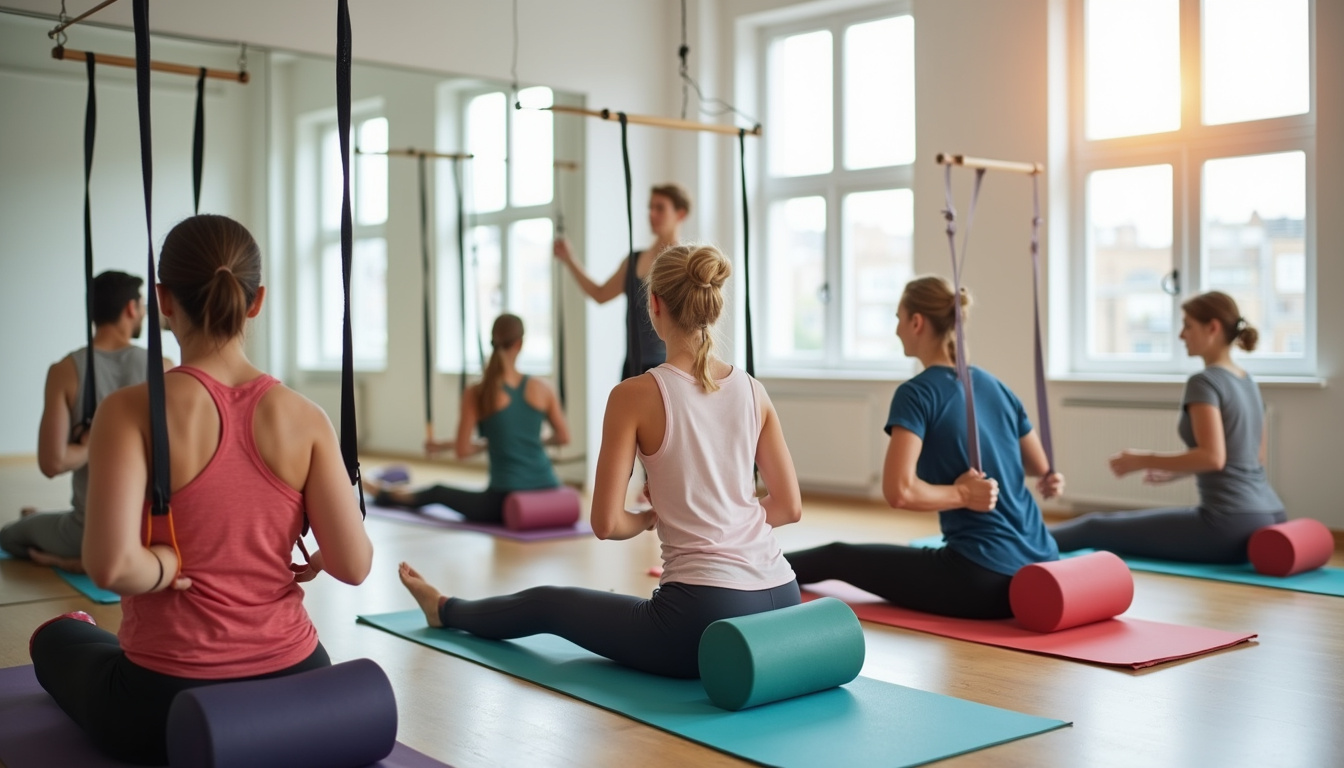
Here are some helpful tips:
-
Increase spring stability, not effort.
A heavier spring may support footwork and supine moves better. -
Shorten the range of motion.
Use half-range footwork, smaller arm springs, and less carriage travel.
This is kinder on sensitive joints. -
Use props generously.
Cushions under your head, pads under your sacrum, a small ball between your knees, or a yoga block under your hand in side work can help a lot. -
Prioritize closed-chain leg work.
Footbar moves, feet in straps with a small range, or wall-assisted standing moves may suit you better than open-chain lifts.
Recovery, Pacing, and When to Back Off
If you use Pilates for fibromyalgia challenges, your body’s recovery is key.
Watch for these signs that you might need to dial back next time:
- You feel very exhausted for more than 24–48 hours after a session.
- You notice widespread, dull aches instead of a “good sore” from muscles.
- Your sleep quality drops right after a hard session.
Keep your practice sustainable by:
- Alternating hard sessions with restorative days focused on breathwork and gentle mobility.
- Adding short pauses between exercises. Sit, breathe, and let your heart rate drop.
- Finishing your session feeling you could do a bit more, not that you barely survived it.
How Nutritional Support Can Complement Your Pilates Practice
When muscles and joints feel off, many seek support from nutrition to help their internal health while Pilates takes care of movement.
Within FDA limits, supplements in the U.S. can support:
- Joint comfort
- Healthy cartilage
- A normal inflammatory response
- Muscle recovery and function
They cannot claim to treat or cure diseases or give a diagnosis.
They also do not replace professional care. Always read labels and discuss supplements with your healthcare provider, especially if you use other medications.
Why Pilates Practitioners Are Turning to Regenerix Gold
Many Pilates practitioners face tight muscles, creaky joints, or post-class stiffness.
They turn to joint and muscle supplements that match the smart choices they make in class.
Regenerix Gold supports people who care about:
- Protecting their joints from daily wear.
- Keeping their mobility comfortable during long planks, spring work, or detailed footwork.
- Pairing studio work with nutritional support for an active lifestyle.
For many teachers, studio owners, and dedicated students, the choice is simple:
- Proactive care now can save expense, pain, and reduced capacity later.
- Strong joints and muscles help you show up for your clients, your work, and your life.
- It feels good to know you truly invest in mind–body wellness.
If you want Pilates for fibromyalgia to work for you, consider pairing gentle, smart work with a support supplement like Regenerix Gold—always with guidance from your healthcare provider.
Regenerix Gold
Taking this step does not mean fear. It means being smart.
You have seen the cost of ignoring your body until it gives way.
As a Pilates practitioner, you know your body well.
Supporting your joints and muscles with thoughtful Pilates and proper nutrition can be one of the best investments in your health, independence, and long-term energy.
FAQ: Pilates and Fibro‑Like Pain & Fatigue
1. Is Pilates good for fibromyalgia‑type muscle pain?
Yes, when you modify Pilates moves, they can help people with chronic muscle pain.
Low‑impact, moderate intensity work, mindful breathing, and joint-friendly alignment can boost mobility and body awareness.
Always check with your healthcare provider first.
2. How often should I do Pilates for chronic pain and fatigue?
Many feel best with 2–4 short sessions per week and at least one full day for gentle mobility or rest.
Start with 10–20 minute sessions.
Gradually increase if you recover well within 24–48 hours.
3. Can gentle Pilates for fibromyalgia‑style symptoms replace other treatments?
No. Pilates is a movement practice, not a medical cure.
Gentle Pilates can add to your care plan by supporting joint mobility, muscle balance, and stress control.
It does not replace advice from your healthcare team, medications, or other treatments.
Supplements like Regenerix Gold are not meant to diagnose, treat, cure, or prevent disease. They only support healthy structure and function as part of a wider wellness plan.
Health Note
Always consult a licensed medical doctor for your health issues.
Special Discount
If you prefer preventive nutrition to minimize expensive knee surgery and potentially addictive pharmaceuticals, Regenerix Gold is your savvy solution.
You qualify for a special discount.
Simply use the link below and a discount will automatically be applied during checkout.
Get Regenerix Gold => HERE


