

If you are new to line dancing and feel pain in your knees, hips, or lower back, you need a good warm up first. A proper line dancing warm up eases your joints, wakes your muscles, and helps your footwork stay safe for moves like the Tush Push, Electric Slide, or Copperhead Road.
Below is a dancer-friendly guide for American line dancers. You may dance on wooden floors in cowboy boots, sneakers, or dance shoes.
────────────────────────────
Why a Proper Line Dancing Warm Up Matters
Line dancers push their bodies hard. They spin, step, and change pace quickly. They get challenges such as:
• Repeated pivots and turns
• Heel digs, toe touches, and grapevines
• Quick tempo changes and stomps
• Long sets on hard floors
Without a proper warm up, you might face stiff hips or knees at first. You may feel tight calves during shuffles and cha-chas. Your lower back might hurt after long hours on the floor. Your feet may feel sore after pivots, stomps, and slides.
A good warm up does these tasks:
- It raises your core body heat.
- It lubricates your joints.
- It activates the muscles you need to dance.
- It prepares your brain for timing, balance, and direction changes.
This warm up is like a rehearsal for your body before you begin a dance session.
────────────────────────────
General Principles for a Safe Line Dancing Warm Up
Keep these rules in mind before you start:
• Begin slowly and then move faster. Start with gentle moves and then reach dance tempo.
• Start with whole-body movement and then move to dance-specific muscles: hips, knees, ankles, and feet.
• Use dynamic movements instead of holding static stretches.
• Respect your body. Mild tension is normal; sharp pain tells you to stop.
• Warm up for 5–10 minutes. Even a short routine is better than none.
────────────────────────────
Step-by-Step Beginner Line Dancing Warm Up Routine (5–10 Minutes)
This routine works in your dance space, right by the line. You do not need special equipment.
1. March & Two-Step Pulse (1–2 minutes)
The goal here is to wake your body and boost blood flow.
• Start by marching in place. Look toward “12 o’clock” as you march.
• Swing your arms naturally; keep your shoulders loose.
• After 30 to 60 seconds, move to a two-step from side to side:
- Step right and bring your left foot next to it.
- Step left and bring your right foot in.
- Add a gentle bounce that fits line dance rhythm.
Keep your weight light on your feet.
2. Hip & Lower Back Mobility (1–2 minutes)
The goal is to open up your hips and lower back for pivots and turns.
• Do pelvic tilts:
- Stand with your feet at hip width.
- Tuck your pelvis under gently and then release.
- Do 10–12 tilts.
• Make hip circles:
- Keep your knees soft.
- Draw slow circles with your hips, 8 circles in each direction.
- Imagine a slow, controlled “cowboy hula hoop.”
• Twist your torso:
- Gently twist from one side to the other.
- Let your arms swing lightly.
- Complete 10–15 twists.
3. Knee-Friendly Prep for Grapevines & Turns (1–2 minutes)
This routine pays attention to your knees and ankles.
• Do mini squats:
- Stand with your feet a bit wider than your hips, toes out.
- Sit back as if you were taking a seat; then rise.
- Do 8–10 shallow squats.
• Rehearse grapevines slowly:
- Gently grapevine to the right: step right, cross left behind, step right, then tap left.
- Repeat to the left side.
- Keep your knees slightly bent and your motion smooth.
- Do 3–4 sets each way at a slow tempo.
4. Ankle, Foot & Calf Activation (1–2 minutes)
This step supports stomps, heel digs, and balance shifts.
• Do heel raises:
- Hold a wall or chair if needed.
- Rise on your toes, hold for one second, then lower slowly.
- Complete 10–15 reps.
• Do toe taps:
- Stand straight and tap one heel in front, then switch.
- Mimic the light heel digs from beginner dances.
- Do 20–30 alternating taps.
• Roll your ankles:
- Hold a support like a chair or wall.
- Rotate one ankle slowly in one direction for 6–8 circles, then switch feet.
5. Simple Line Dancer Dynamic Stretch Series (1–2 minutes)
Keep your main dance muscles loose without long holds.
• Try hamstring scoops:
- Step forward with one foot, heel down and toes up.
- Push your hips back slightly and let your hands sweep down before rising again.
- Do 6–8 scoops for each leg.
• Do the quad walk:
- Step forward and then grab your back foot.
- Gently pull your heel toward your seat, then move forward.
- Do 4–6 steps for each leg or use a wall for support.
• Do side lunges:
- Step to the right and bend your right knee while keeping your left leg straight.
- Return to center and repeat on the left.
- Do 6–8 lunges in total.
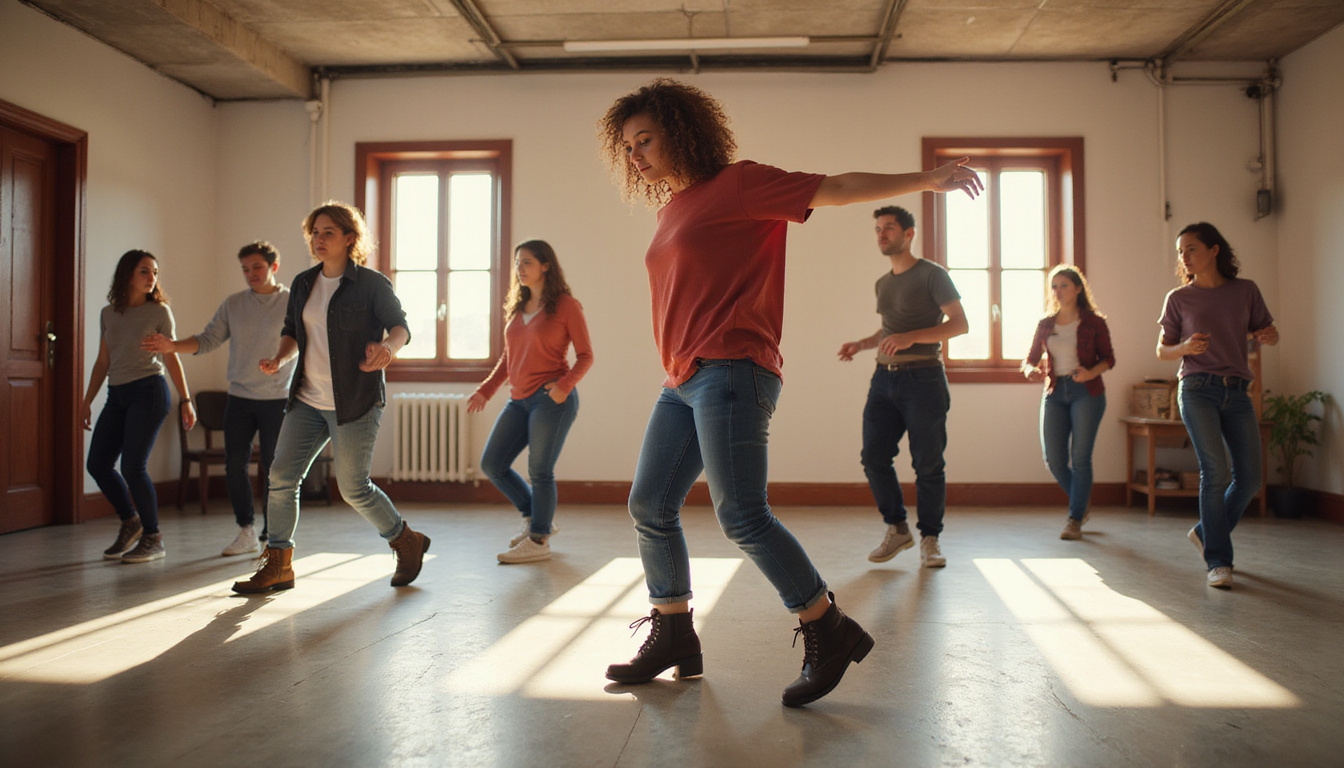
When you finish, you should feel warmer and more flexible as you approach your dance wall.
────────────────────────────
Adding Dance-Specific Moves to Your Line Dancing Warm Up
When you are comfortable with the basics, add moves from your dance class. This step primes your body for what you will do on the floor.
You can include:
• Slow shuffles (triple steps)
• Partial pivots (quarter and half turns)
• Slow coaster steps
• Side touches and toe fans
Here is one example:
-
Slow Shuffle Drill
- Step forward with your right foot, then bring your left foot next to it, and step forward again with your right foot.
- Repeat on the opposite side with light, small steps and a soft bounce. -
Quarter Turn Walks
- Walk forward for 4 counts before slowly turning ¼ left.
- Focus on turning with your hips and feet, not just your knees. -
Side Touch Combos
- Step right and touch your left foot beside it.
- Step left and touch your right foot beside it.
- Add small arm swings to feel your full-body rhythm.
────────────────────────────
Common Warm Up Mistakes Line Dancers Make
Even skilled dancers make errors. Avoid these pitfalls:
• Do not jump into a fast dance without warming up. Going from your car or office chair to a high-energy dance can cause stiffness.
• Do not wait to stretch until you feel sore. Warming up before dancing helps you move better.
• Do not hold deep static stretches when you are cold. Save these stretches for after the dance.
• Do not use worn-out boots or unsupportive shoes. Bad footwear can worsen discomfort.
• Do not push through sharp pain. Mild fatigue is normal, but sharp pain is a sign to stop and seek help if needed.
────────────────────────────
Beyond Warm Ups: Supporting Your Body for More Nights on the Floor
A warm up is one part of a complete self-care routine. Many dancers also use these tips:
• Drink plenty of water before and during dancing.
• Listen to your body when it sends early warning signs like stiffness or pain.
• Build strength in your glutes, core, and calves between classes.
• Follow a balanced eating plan to support your energy and muscle health.
Some dancers also choose dietary supplements made to support joint and muscle health. These are not meant to diagnose, treat, cure, or prevent any disease. They work best when used as directed and as part of a healthy lifestyle.
Always talk with your healthcare provider before adding any new supplement, especially if you have health concerns, take medications, or are pregnant or nursing.
For general joint-health ideas on nutrition and movement, you can check organizations like the Arthritis Foundation (source: https://www.arthritis.org).
────────────────────────────
Simple At-Home Pre-Class Routine for Beginner Line Dancers
If you need a quick checklist warm up before you head to the honky-tonk or community hall, try this:
- March in place – 1 minute
- Hip circles and torso twists – 1 minute
- Mini squats and slow grapevines – 2 minutes
- Heel raises and toe taps – 2 minutes
- Dance-specific moves (slow shuffles and quarter turns) – 2–3 minutes
Total time: about 8–10 minutes. Do these moves while playing your favorite line dance track softly to get into the groove.
────────────────────────────
FAQ: Line Dancing Warm Up Questions
1. What is a good beginner line dancing warm up if I have little time?
For a 3–5 minute warm up, focus on these moves:
• 1 minute of marching or a two-step
• 1 minute of hip circles and torso twists
• 1 minute of mini squats and heel raises
• 1–2 minutes of slow grapevines and shuffles
Even this small routine beats dancing cold.
2. How often should I warm up if I dance several nights a week?
Warm up every time you dance. Whether you take a class, join a social dance, or practice at home, your body needs to prepare. Regular warm ups help you move better and reduce tightness.
3. Can a line dancing warm up help with stiffness from sitting all day?
Yes. A simple routine that includes marching, hip circles, torso twists, heel raises, and slow grapevines can shake off stiffness from sitting. While it does not treat medical conditions, many dancers find these movements help them feel looser and more comfortable.
────────────────────────────
A Smart Extra Step: Supporting Joints and Muscles with Regenerix Gold
As a line dancer, you invest in boots, classes, and gear to hit the dance floor. Yet the best gear is your body—your feet, ankles, knees, hips, and back. These parts let you spin, stomp, and keep the beat.
Along with a proper warm up, many dancers seek extra support for joint and muscle health. A premium dietary supplement like Regenerix Gold can help with this support. Regenerix Gold is made for adults who want to stay active and support their joints and muscles. It does not diagnose, treat, cure, or prevent disease. Use it as directed, along with a balanced diet and regular movement.
If you want to keep dancing so you do not miss a step, consider these points:
• You want to stay on the dance floor instead of sitting out.
• You plan ahead to avoid expensive medical care and time off.
• You value being the smart one who prepares for the long run.
• You see dance as a part of a healthy and active life—not just a weekend activity.
Warming up well, moving regularly, and using a high-quality supplement like Regenerix Gold can help you dance with more ease. If you care about your joints and muscles as much as your next choreography, ask your healthcare provider if adding Regenerix Gold is right for you. Combine it with the warm up routines above to make every dance move feel smoother.
Regenerix Gold
Health Note
Always consult a licensed medical doctor for your health issues.
Special Discount
If you prefer preventive nutrition to minimize expensive knee surgery and potentially addictive pharmaceuticals, Regenerix Gold is your savvy solution.
You qualify for a special discount.
Simply use the link below and a discount will automatically be applied during checkout.
Get Regenerix Gold => HERE


