

If you feel your calf tighten every time you get up, walk downstairs, or bend your knees, you are not alone. Many people in America have knee soreness or stiffness and also feel their calves get knotted, tight, and achy. That “pulled rope” feeling in the back of your lower leg makes each step heavy, strains your knees, and makes simple acts—like getting out of the car or walking across a parking lot—hard.
This guide shows why your calves tighten, explains their link to your knees, and lists the best stretches, fixes, and nutrition support. It also discusses how a supplement like Regenerix Gold may help keep your knee joints and muscles healthy from the inside out.
Why Calf Tightness Shows Up When Your Knees Already Hurt
When your knees ache, your body changes how it moves. You may:
- Put more weight on one leg
- Avoid fully bending or straightening your knee
- Shorten your stride to "protect" the joint
These habits force your calves to work harder. Your gastrocnemius—the big calf muscle that crosses your knee—and your soleus—a deeper calf muscle near the Achilles—start to work even more.
This shift leads to:
- A constant "cramp-ready" feeling
- A pull behind your knee
- A tight band from your knee to your heel
- A feeling that you "can’t straighten" your leg without a tug
Calf tightness may also come from:
- Sitting too long (driving, desk work, TV time)
- Wearing shoes with poor support or high heels
- Starting to walk, jog, or play sports without a warm-up
- Not drinking enough water or eating balanced meals
The result is short, tight calves, and your knees must work harder with every step. Your legs may feel older than you are.
How Tight Calves Make Your Knees Work Harder
If you listen to every click, twinge, or catch in your knee, this matters.
Tight calves can:
- Limit how far your ankle can bend (dorsiflexion). This change makes your knee track over your foot in a different way.
- Pull on the back of your knee so that both straightening and bending hurt.
- Shift your weight forward so your knees absorb more impact when walking or going downstairs
Many people share that:
- "My knees feel jammed and my calves feel like guitar strings."
- "I can’t squat down without my calves screaming and my knees complaining."
Fixing calf tightness may ease the pressure on your knee joint, which lets your legs move more freely.
Quick Self-Check: Is Calf Tightness Part of Your Knee Problem?
Watch for these signs of calf tightness:
- A need to "walk it out" after sitting, because your lower legs feel stiff
- A sharp stretch when you drop your heel off a step
- Tender calves when you massage them with your thumbs
- A pull behind your knee when you try to fully straighten your leg
If these sound like you, working on your calves can be a smart and low-risk way to relieve your knee tightness.
The Best Daily Stretches for Calf Tightness (Knee-Friendly)
Always move slowly into these stretches. Do not push into sharp pain. If you have a doctor’s care, check with them before you start.
1. Wall Calf Stretch (Straight Back Leg)
This classic move opens the large calf muscle that runs behind your knee.
- Stand facing a wall. Place your arms at shoulder height on the wall.
- Step your tight leg back. Keep your heel flat and your toes pointing forward.
- Bend your front knee. Keep the back knee straight and your heel on the ground.
- Lean your hips toward the wall until you feel a steady stretch in your upper calf.
- Hold for 20–30 seconds while you breathe slowly. Repeat 2–3 times per side.
Tip: Do not over-bend your front knee. Keep your knees aligned with your toes. Avoid letting them collapse inward.
2. Bent-Knee Calf Stretch (Targets the Deeper Soleus)
This stretch is best if you feel deep tightness in your lower calf or near your Achilles.
- Use the same position as the wall stretch.
- Bend both knees slightly while keeping the back heel on the ground.
- You will feel the stretch move lower in the calf muscle of the back leg.
- Hold for 20–30 seconds and do 2–3 repetitions.
This move puts less stress on your knee joint while it still warms the deep muscle.
3. Step Drop Stretch (For “Brick-Like” Calves)
Only use this stretch if you have good balance and your knees can handle standing on a step.
- Stand on a step so both feet are on the edge. Hold a rail or a wall if needed.
- Slowly lower your heels below the step until you feel a stretch.
- Keep your knees slightly bent if they feel sensitive; do not lock them.
- Hold for 20–30 seconds, then lift your heels back up.
- Repeat 2–3 times. You can later try one leg at a time if you like.
This stretch mimics the lowering part of a calf raise and lengthens the entire back of your lower leg.
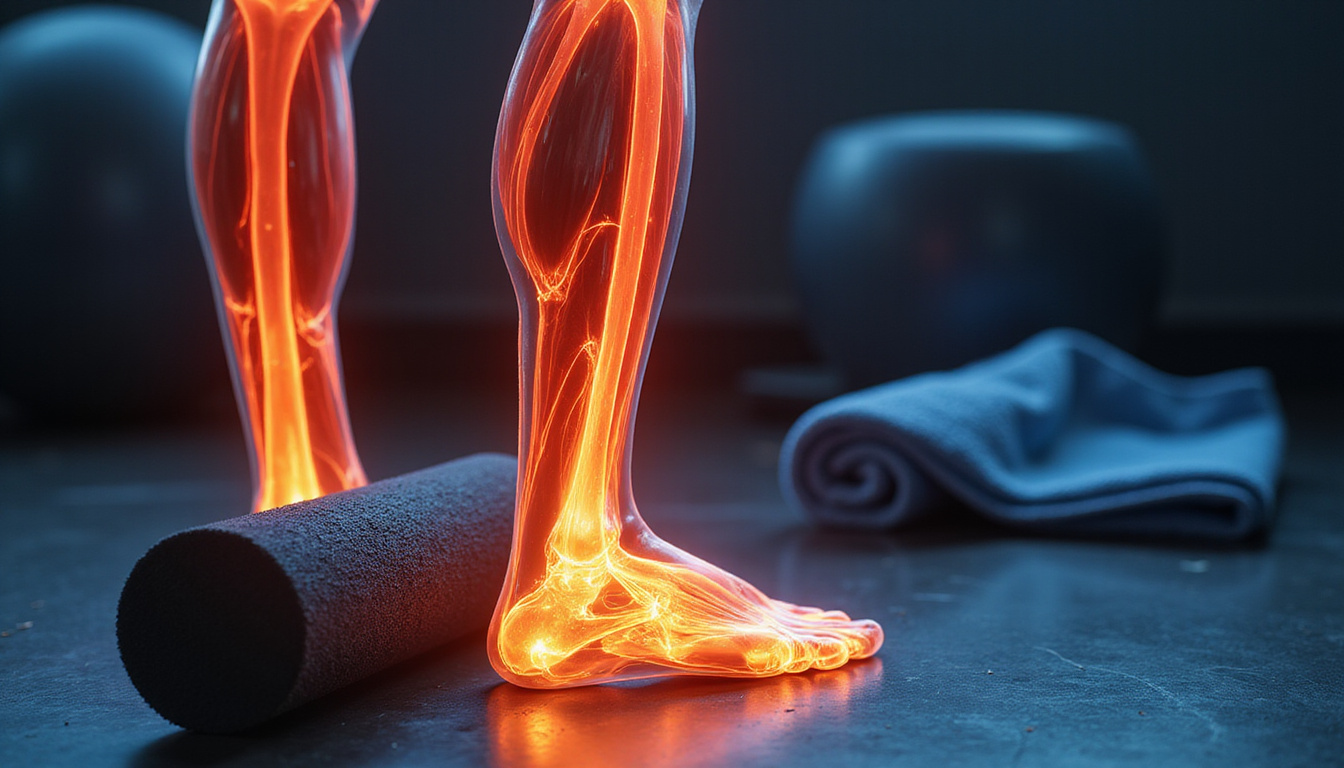
4. Seated Towel Stretch (Chair-Friendly)
This stretch helps if standing makes your knee pain worse.
- Sit on the floor or a firm bed with one leg stretched out in front of you.
- Loop a towel or belt around the ball of your foot.
- Keep your knee slightly bent to protect the joint.
- Gently pull the towel toward you until you feel a calf stretch.
- Hold for 20–30 seconds as you breathe steadily. Repeat 2–3 times.
You can also do this stretch in a chair by resting your heel on another chair or stool.
Simple Strength Moves That Calm Down Calf Tightness
Strengthening your calves can make them feel less tight over time. Strong and flexible muscles tend to “complain” less.
Try these moves 2–3 times per week:
-
Double-Leg Calf Raises at a Counter
- Stand by a counter that is sturdy.
- Slowly rise onto your toes. Pause, then lower yourself slowly.
- Do 2 sets of 8–10 repetitions.
- Keep your knees soft, not locked. Distribute your weight evenly.
-
Seated Calf Raises
- Sit in a chair with your feet flat on the ground.
- Lift your heels as high as you can without pain. Lower slowly.
- Do 2 sets of 12–15 repetitions.
- This exercise is gentle on the knees and works well when your knees feel sensitive.
If you feel sharp knee pain, stop immediately and talk to a physical therapist.
Lifestyle Fixes That Loosen Up Tight Calves and Help Your Knees
Calf tightness does not only require stretching; daily habits make a change.
Try these ideas:
- Footwear check: Choose shoes with cushioning and good arch support. Avoid unsupportive flats or high heels.
- Move every 45–60 minutes: If you sit for long periods, stand up, take a brief walk, or do 10–20 easy calf raises or a quick wall stretch.
- Warm up before activity: March in place, make ankle circles, and do light calf raises to warm up your muscles.
- Ease into new activities: Do not jump from little activity to long walks or intense workouts overnight.
- Hydration and nutrition: Drinking enough water and eating well can help your muscles avoid cramping and fatigue. (source: NIH Office of Dietary Supplements)
These small habits support your calves and the entire leg chain—from your foot to your knee to your hip.
Nutrition Support for Calves and Knees: Where Regenerix Gold Fits In
Outside work like stretching and strengthening is one side of the coin. Your joints and muscles also need support from the inside. Many people in America use nutrition support along with their daily routines to help with calf tightness and knee discomfort.
Regenerix Gold is a supplement for people who want healthy knee joints and muscles. It supports the groups that affect how your knees feel—the calves, hamstrings, and quadriceps.
Here is how it works:
-
Nutrition-based approach
It gives you targeted nutrients for joint and muscle health. This supplement is not a drug. It does not treat a disease. It supports your body’s natural ability to keep joints moving and muscles strong. -
Recommended by doctors and physical therapists
Many professionals suggest Regenerix Gold as part of a plan that includes exercise, stretching, weight management, and other healthy habits. -
Used internationally for over a decade
For more than ten years, people around the world have used Regenerix Gold. Those who are tired of feeling limited by their knee and calf issues include it in their overall support plan. -
Fits easily into your daily routine
Many people take Regenerix Gold with:- Regular calf and hamstring stretches
- Gentle leg strength exercises
- A focus on nutrient-rich food and hydration
- Advice from their healthcare provider
Remember to read the label carefully. Speak with your doctor or pharmacist if you are pregnant, nursing, have health issues, or take prescription medications.
Putting It All Together: A Daily Routine to Ease Calf Tightness
Here is a sample day that mixes stretches, lifestyle changes, and nutrition support. Adjust these steps to your schedule and follow your provider’s advice:
-
Morning (5–10 minutes)
- Do the seated towel stretch for 2–3 rounds per leg
- Perform 1–2 sets of seated calf raises
- Take Regenerix Gold as directed if your provider agrees
-
During the day
- Every hour, stand up and walk for 1–2 minutes
- Do 10 easy double-leg calf raises at a counter
- Stay hydrated and choose nutrient-rich meals
-
Evening (5–10 minutes)
- Do the wall calf stretch. Use both straight-leg and bent-knee versions
- Try the gentle step drop stretch if your knees feel okay
- Massage your calves gently with your hands or a massage ball
Small, consistent efforts like these often work better than an occasional long session that leaves you sore.
Video: Learn More About Supporting Your Knee Joints and Muscles with Regenerix Gold
Regenerix Gold
FAQ: Calf Tightness and Knee-Friendly Solutions
-
Why do I get calf tightness at night when my knees already hurt?
At night, your calf may tighten because you have moved differently during the day. Your shoes, your fluids, and your muscle fatigue all play a role. Try gentle stretching before bed, drink enough water, and discuss nutrition support like Regenerix Gold with your provider. -
What is the fastest way to relieve calf muscle tightness without upsetting my knees?
A mix of a light warm-up walk, followed by wall calf stretches (both straight and bent-knee), plus seated calf raises may work best. Warmth and supportive shoes also help. Start slow and stop if you feel sharp pain. -
Can a joint supplement help with leg and calf tightness linked to my knees?
Joint supplements like Regenerix Gold do not cure or treat disease. They are made to support healthy knee joints and muscles from the inside. Many users say that when they combine the supplement with regular stretching, strength work, and smart daily habits, their legs feel less tight and more able to move. Discuss these options with your healthcare provider.
Take the Next Step: Don’t Let Calf Tightness Control Your Knees—or Your Future
Calf tightness does not have to rule your life, even when it worsens knee discomfort. Simple stretches, basic strength work, smart daily habits, and a thoughtful nutrition plan can help shift the balance in your favor.
If you plan ahead and care about your long-term health—including managing medical costs, work time, or lost independence—it makes sense to invest in leg care now. Many health-savvy people use tools like Regenerix Gold as part of their plan for healthy knee joints and muscles before problems worsen.
Consider getting a bottle of Regenerix Gold and pairing it with the stretches and routines in this guide. Give yourself the chance to feel it when your calves and knees work with you instead of against you. Stay active, confident, and in control of your mobility.
Health Note
Always consult a licensed medical doctor for your health issues.
Special Discount
If you prefer preventive nutrition to minimize expensive knee surgery and potentially addictive pharmaceuticals, Regenerix Gold is your savvy solution.
You qualify for a special discount.
Simply use the link below and a discount will automatically be applied during checkout.
Get Regenerix Gold => HERE


