
delivery driver back pain: simple stretches, posture fixes, and relief
by Zestora on Dec 16, 2025

If you finish a long route and sit in the cab for five extra minutes because your lower back shouts in pain, you are not alone.
Delivery driver back pain has become a regular part of the job. Tight deadlines, heavy boxes, awkward stairs, and long hours in the driver's seat do not create a happy spine.
This guide helps American delivery pros—package drivers, parcel couriers, gig drivers, food and grocery drivers—who feel the strain on their backs, hips, and shoulders. It offers fixes you can use on route.
Why delivery driver back pain is so common
Your back takes hits from many sides in this work:
- You sit long behind the wheel with a stiff posture.
- You bend repeatedly to get in and out of the cargo area or trunk.
- You twist to grab packages behind the seat.
- You carry awkward loads up stairs, into elevators, or along long driveways.
- You hurry to keep to tight routes and may skip warm-ups and breaks.
Day after day, these habits make muscles tighten. Joints stiffen. You notice:
- Your lower back aches after a full route.
- Your back feels tight or locks up as you exit the vehicle.
- Your hips or hamstrings become stiff and make bending hard.
- Your upper back and shoulders hold tension from steering and lifting.
This is not just about aging. It is strain from the job. You can manage it with small, steady changes.
Step one: reset your driver’s seat for your back
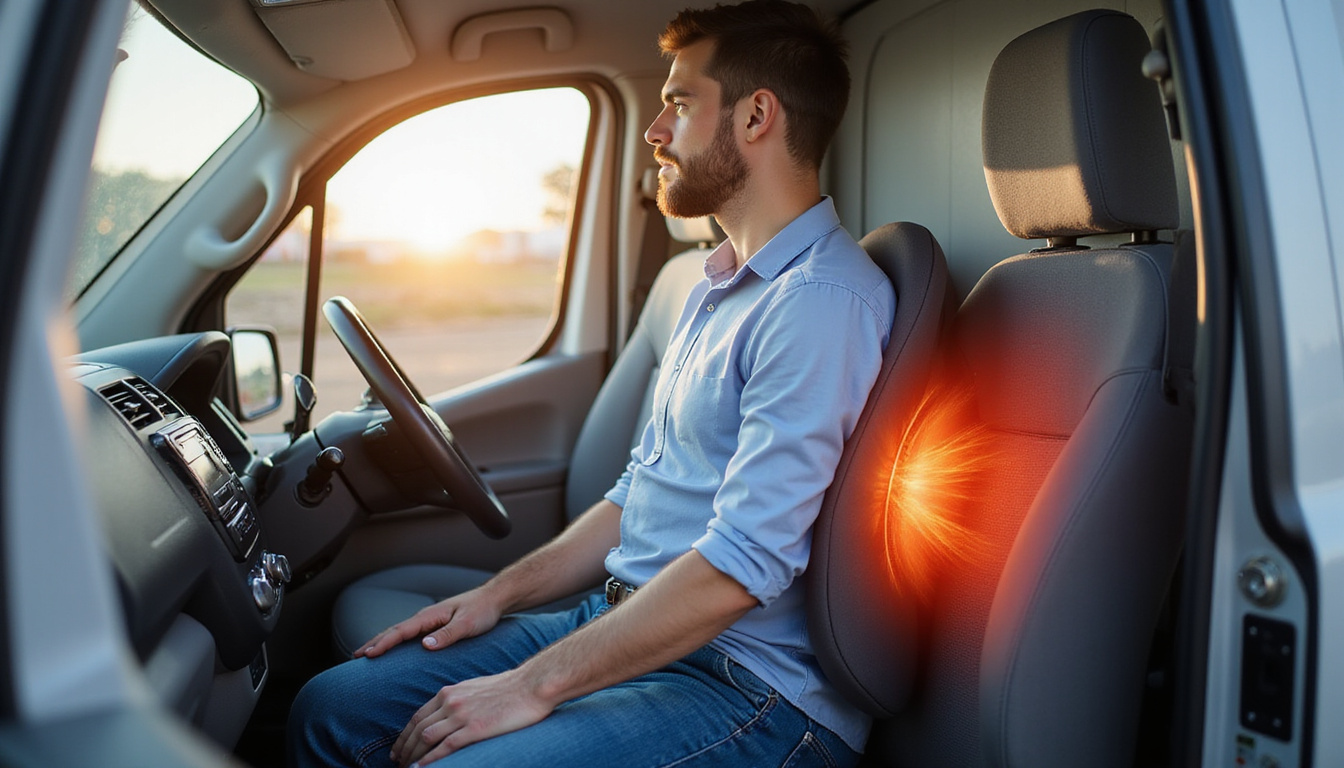
You sit in your driver’s seat for long hours. If your seat is not set right, your back pays for it all day.
Seat position: bring the pedals to you (not you to the pedals)
- Distance: Adjust the seat so your knees bend a bit. You can press the pedals fully without reaching. Reaching pulls your lower back forward.
- Seat height: Sit so that your hips are near or a bit above your knees. This lessens pressure on your lower back.
- Recline angle: Choose a slight recline around 100–110 degrees. Do not sit fully upright. Sitting too upright or too reclined forces your back to work too hard.
Lumbar support: stop the slump
Most delivery vehicles do not think of your spine. Use a rolled-up towel, a small pillow, or a lumbar cushion placed at the small of your back. Adjust the backrest so your lower back stays in gentle contact with the support.
If you catch yourself slouching or leaning on one elbow on the armrest, you need stronger lumbar support.
Steering wheel and arm position
- Bring the wheel near and slightly lower so your shoulders relax.
- Let your elbows bend comfortably. They should not be fully straight nor cramped.
- Do not lean on one side or twist your torso to reach the wheel.
These small tweaks add up for a driver who sits 8–12 hours each day, reducing back fatigue by the end of the shift.
Simple on-the-job stretches for delivery driver back pain
You do not need a gym or yoga mat. You need 30–60 seconds here and there. Do them when your vehicle is safely parked or between stops.
1. “Tailgate” hamstring stretch
This stretch helps when your leg muscles pull on your lower back.
- Place one heel on a bumper, step, or low ledge (or on the cab floor with the door open).
- Keep your knee slightly bent and not locked.
- Hinge forward from your hips, not your back, until you feel the stretch in the back of your thigh.
- Hold for 15–20 seconds. Breathe steadily. Then switch legs.
2. Standing hip flexor stretch (driver’s side lunge)
Sitting makes your hips tight. This stretch eases the tension.
- Stand near the truck or van for balance.
- Step back a little with one foot.
- Bend your front knee a bit and gently push your hips forward.
- You feel the stretch in the front of the hip of your back leg.
- Hold for 15–20 seconds. Then switch sides.
3. Seated lower-back reset (in the cab, engine off, parked safely)
- Sit tall with both feet flat on the floor.
- Place your hands on your thighs.
- Gently arch your lower back as you push your chest forward and then slowly round it by tucking your tailbone.
- Move slowly between these two positions for 8–10 reps.
This move keeps your spine in motion instead of locking in one stiff position.
4. Door-frame chest and shoulder opener
Hunching forward to steer and grab packages makes your chest tight. This stretch helps the back.
- Stand in the doorway of the cargo area or open vehicle door.
- Place your forearm or hand on the frame at shoulder height.
- Gently turn your body away until you feel the stretch in your chest and the front of your shoulder.
- Hold for 15–20 seconds on each side.
5. Gentle side bend for the “delivery driver lean”
Your spine gets used to the same pattern if you always twist one way to pick up packages.
- Stand with your feet at shoulder-width.
- Slide one hand down the outside of your leg as you lean gently to that side.
- Keep your chest forward without twisting your torso.
- Hold for 10–15 seconds. Then repeat on the other side.
Do 2–3 of these stretches every couple of hours. Think of them as a fuel stop, a bathroom break, or a pause after a heavy staircase run.
Smarter lifting and carrying: protect your back while you hustle
You know the rule “lift with your legs.” But real-life routes are not textbook. You face tight stairwells, strange porches, loose gravel, and heavy boxes.
These tweaks can help:
- Get closer to the load. Keeping the box near your body reduces the strain on your back.
- Use your legs from the start. Hinge from your hips, bend your knees, keep your back neutral, and push through your heels.
- Do not twist with heavy loads. Turn using your feet, not your spine. Tiny twists count over a route.
- Split the load if possible. Two easier trips with lighter loads are better than one heavy carry that makes your back ache.
- Use handles, carts, or dollies. If your company does not give you one, a simple dolly may save you from future wear and tear.
- Plan your path to the door. Look for smooth paths, ramps, or fewer steps. Sometimes a small detour cuts down your strain.
Think of your back as critical equipment. If you exhaust it, nothing else matters.
Micro-breaks: how to move without losing time
Many drivers skip breaks because the clock is in their mind. Micro-breaks do not have to add a full stop.
Try these tiny resets:
- Stand tall. Roll your shoulders 5–10 times every 2–3 stops.
- Take two quick hamstring stretches while waiting at a safe dock or gate.
- Walk briskly around the vehicle for 30 seconds every couple of hours.
- Lean back gently with your hands on your hips. Do 5 slow, mini back bends after a heavy lift.
These moves are not full gym sessions. They are little maintenance moves that stop tension from growing until it hurts.
Support from the inside: nutrition and supplements for joints and muscles
Stretches and a proper seat are vital. But many drivers also support their muscles and joints from the inside.
Note these points:
- Supplements are not drugs. They cannot diagnose, treat, cure, or prevent any disease.
- They can support normal joint function, muscle comfort, and overall wellness when taken with a balanced diet and healthy habits.
For drivers on the road day after day, think of these tips:
- Hydration: Muscles and connective tissues work well when you drink enough water instead of only coffee.
- Protein: It helps repair muscles after long, physical shifts.
- Joint-supporting nutrients: Many drivers take simple daily nutrients that support flexibility and comfort.
Always check with a healthcare professional before you start any supplement, especially if you already take medication or have other health issues (source: NIH Office of Dietary Supplements).
A realistic back-care routine for busy delivery drivers
You can build a back-care system into your day without adding extra stops:
-
Pre-route (5 minutes while the truck warms up):
- Do one set of hamstring stretches for both legs.
- Do one set of hip flexor stretches on both sides.
- Do 8–10 seated spine “arch and round” movements.
-
Mid-morning quick reset (1–2 minutes):
- Roll your shoulders 5–10 times.
- Do two gentle side bends per side.
- Take a short walk around the vehicle.
-
Lunch or mid-shift (3–4 minutes):
- Repeat hamstring and hip flexor stretches.
- Do one set of door-frame chest stretches.
-
Post-route (3–5 minutes before you drive home):
- Do light stretches for your hamstrings, hips, and lower back.
- Take a short walk around the lot to loosen up after sitting and lifting.
Also add a well-adjusted driver’s seat, smarter lifting habits, consistent hydration, good nourishment, and if you choose, a daily joint-and-muscle-support supplement.
You are not just "toughing it out." You manage the job’s strain like a pro.
FAQ: delivery driver back pain and relief
1. What helps with delivery driver lower back pain during long routes?
Many drivers find relief by using:
- A better seat setup with strong lumbar support, proper distance to pedals, and a gentle recline.
- Micro-breaks to stretch hamstrings and hips.
- Smarter lifting by keeping boxes near the body and avoiding twisting.
- A consistent routine that includes good hydration, healthy nutrition, and sometimes a daily supplement for joint and muscle support.
If pain is strong or does not get better, please speak with a healthcare professional.
2. Are there quick stretches for drivers with back pain between stops?
Yes. For delivery driver back pain relief on the go, try:
- A standing hamstring stretch using the vehicle bumper or a low step.
- A hip flexor stretch near the truck.
- A seated lower-back “arch and round” exercise in the cab when parked safely.
- A door-frame chest stretch from an open cargo door.
Even 30–60 seconds every few hours can help.
3. Can supplements help with back discomfort from delivery work?
Supplements do not diagnose, treat, cure, or prevent any disease. They are not a substitute for proper lifting, posture, or medical care. However, some drivers include joint and muscle support supplements in their routine to help with:
- Normal joint flexibility and comfort.
- Muscle function and recovery.
- Overall resilience for a demanding job.
Always discuss any supplement with a healthcare professional before starting.
You can also watch this short FAQ video about Regenerix Gold for more details:
https://youtu.be/mGrH5UWFxUs?si=X9bScbG6dvejGkZf
Why savvy delivery drivers are turning to Regenerix Gold
Your body is the tool you need for delivery work. When your back, knees, shoulders, and hips feel tired or worn out, it affects your route, your pay, and your job security.
Many drivers think like business owners about their bodies. Prevention is cheaper than medical bills, time off work, or a forced career change. This is where Regenerix Gold helps.
Regenerix Gold is a premium supplement made for those who want to support healthy joints and muscles. It is for drivers who:
- Put many miles on their bodies daily.
- Care about staying active and functional rather than just "getting by."
- Want to live optimally without being held back by stiffness and pain.
While Regenerix Gold does not diagnose, treat, cure, or prevent any disease, it supports normal joint and muscle health so you can lift, climb, and hustle without extra pain.
In an industry where one bad week can mean lost hours, missed tips, or job worries, the smartest drivers take steps now—before things worsen. If you see yourself as a true professional and not just someone who drops off boxes, your joints and muscles deserve the same care as your vehicle and equipment.
If you want to stay in the game, protect your income, and feel that your best years are still ahead, consider adding Regenerix Gold to your routine. Do it alongside the stretches, seat adjustments, and smarter lifting steps you now know.
https://youtu.be/mGrH5UWFxUs?si=X9bScbG6dvejGkZf
Health Note
Always consult a licensed medical doctor for your health issues.
Special Discount
If you prefer preventive nutrition to minimize expensive knee surgery and potentially addictive pharmaceuticals, Regenerix Gold is your savvy solution.
You qualify for a special discount.
Simply use the link below and a discount will automatically be applied during checkout.
Get Regenerix Gold => HERE


