

If you feel a sharp stab or deep ache as you take the first step down, you are not alone. Many Americans face downstairs knee pain. They grip the railing, take one step at a time, and wince with every descent. A pulling feeling behind the kneecap, grinding under the patella, or a dull throb after a long day makes stairs something to dread.
This guide gives you practical moves and people-tested strategies. You will learn 7 simple moves to help you go up and down stairs with more confidence. There is also a nutrition-based option, Regenerix Gold, that many doctors and physical therapists suggest for healthier joints and muscles.
Why Does Going DOWN Stairs Hurt More Than Going Up?
Many people say, “I can go up fine, but going down is brutal.” This feeling is real.
When you step down: • Your knee bears your body weight. • Your joint takes more load when bent. • The kneecap area gets more pressure and friction.
You may feel:
• A sharp jab under the kneecap as you step down
• A grinding sensation, like sand in the joint
• A pulling or pinching on the inside or front of your knee
• Pain that stays after you reach the bottom
These are common reports from people with downstairs knee pain.
A doctor must check your condition. But you can still change your daily moves to protect your joints.
Move #1: Fix Your Stair Technique (Today)
Form matters. A small change in your step can lower knee stress.
Try this next time on stairs:
-
Use your stronger leg first when stepping down.
Use the better leg first, then let the painful leg follow. -
Grab the railing firmly.
Your arms help take load from your knees. -
Keep your knee aligned over your second toe.
Do not let the knee cave inward. This twist makes your knee hurt. -
Shorten your step.
Plant your whole foot on each step. Avoid leaving your heel hanging. -
Lean slightly forward at the hips.
A slight lean moves stress from your knees to your hips and glutes.
Think of these steps as slow, controlled, and stable. Do not rush or force a painful jolt.
Move #2: The Chair-Sit Drill (Build Stair Control Safely)
If sitting is hard, stairs will be harder. This simple drill builds control for safe stair use.
Do this:
• Stand in front of a sturdy chair with feet hip-width apart.
• Sit slowly over 3–4 seconds. Lightly touch the seat and stand up.
• Keep your knees apart.
• Do 2–3 sets of 8–10 reps, 3–4 days a week if you feel okay.
If this is too hard, use your hands on your thighs or the armrests. Over time, use less arm support as your legs get stronger.
This drill mimics stair use in a safer, low-stress way.
Move #3: Wall Sit “Mini-Holds” to Wake Up Your Thighs
Weak or lazy thigh muscles force the knee to work too hard.
Try this:
• Stand with your back against a wall.
• Slide down a little, like a quarter squat.
• Hold for 10–20 seconds. Feel your thigh muscles work.
• Do 3–5 holds with rest in between.
If you feel too much pressure on the knee, slide up a bit. The goal is gentle muscle work, not pain.
Move #4: Step-Down Practice (One Inch at a Time)
Use a very low step to retrain your body.
You need a bottom stair, low step, or sturdy platform about 2–4 inches high.
Do this:
• Stand on the step with both feet.
• Gently tap one heel to the floor, then lift it back up.
• Keep your chest up and your knee aligned with your toes.
• Do 5–8 taps each side for 1–2 sets.
As you grow comfortable, add another set or slowly increase the height. Use a railing or counter if you feel unstable.
This move teaches your leg to control your body as you step down.
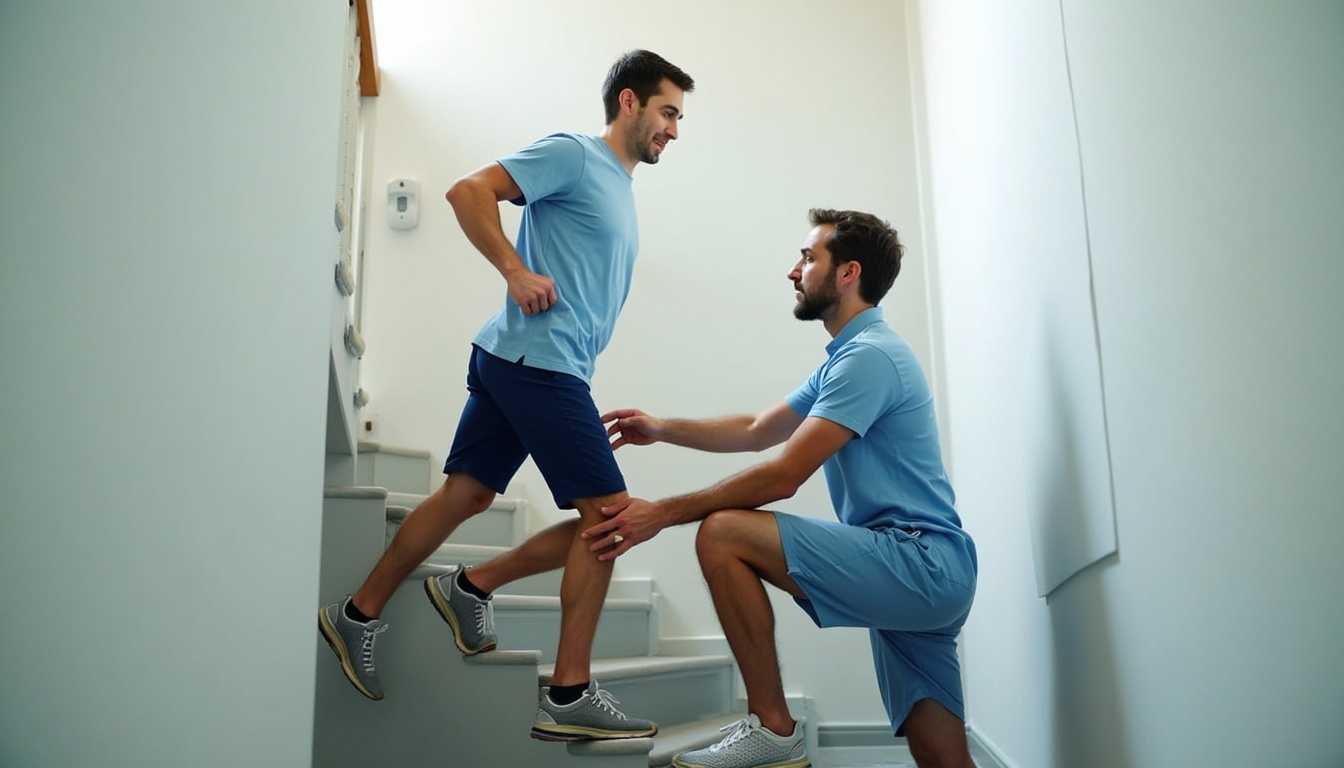
Move #5: Hip and Glute Strengtheners (Take the Load Off Your Knees)
When your hips and glutes work less, your knees must absorb more load.
Try two simple moves:
-
Side-Lying Leg Raise
• Lie on your side with the bottom leg bent and the top leg straight.
• Lift the top leg slowly, keeping your toes facing forward.
• Lower the leg with control.
• Do 2 sets of 10–15 reps on each side. -
Standing Hip Abductions (Counter Support)
• Stand sideways near a counter or chair.
• Lift the outer leg slightly to the side.
• Keep your toes forward without twisting.
• Do 2 sets of 10–15 reps on each side.
These moves help your muscles take more load. When these muscles wake up, stairs feel better.
Move #6: Gentle Quad Stretching for That Tight-Front-of-Knee Feel
A tight front thigh may pull on your kneecap. A light stretch can help.
Do a standing quad stretch:
• Hold a wall or chair for support.
• Bend one knee and bring your heel to your buttocks.
• Hold your ankle or pant leg if you can reach it comfortably.
• Keep your knees close; do not pull hard.
• Hold for 20–30 seconds and repeat 2–3 times on each side.
Stretch gently. Do not force a sharp pain.
Move #7: Daily “Micro Adjustments” That Add Up
Small habits can make a big difference:
• Avoid deep squats or long periods of kneeling when your knees hurt.
• Break up long sitting sessions. Stand and walk every 30–60 minutes.
• Wear supportive, cushioned shoes. Thin or worn-out soles make stairs harder.
• Use the elevator or ramp on high-pain days.
• Warm your knee area with a warm pack before high activity.
These micro adjustments are simple. They keep your knee pain from worsening.
How Nutrition Fits In: Supporting Joints From the Inside
Muscles, cartilage, and connective tissues need good nutrition. A balanced diet and exercise are key. Many people add supplements to help joint and muscle comfort.
The NIH shows that many ingredients support joint health. These ingredients do not cure conditions but help overall comfort.
This is where Regenerix Gold comes in as a nutrition-based option.
Regenerix Gold: A Nutrition-Based Ally for Stair-Ready Knees
Regenerix Gold is a nutrition-based solution for healthy joints and muscles. It is for those who worry about downstairs knee pain during stairs or daily tasks.
It is not a drug. It does not claim to diagnose, treat, or cure disease. It offers nutrients that many people use to help:
• Support joint function and mobility
• Keep movement comfortable
• Nourish muscles and connective tissue under load
Many doctors and physical therapists recommend Regenerix Gold. For over a decade, users around the world have given positive feedback. They say it helps them move, climb, and stay active.
Here is the required video, placed just after introducing Regenerix Gold:
<iframe width="560" height="315" src="https://youtu.be/mGrH5UWFxUs?si=enLOx67aeklAOHfA" title="Regenerix Gold Video" frameborder="0" allowfullscreen></iframe>
Users say Regenerix Gold:
• Offers a joint-focused nutrition option
• Fits easily into a daily routine
• Supports long-term joint care instead of a quick fix
Always discuss any supplements with your healthcare provider, especially if you take other medications or have conditions.
Putting It Together: A Simple Weekly Game Plan
If downstairs knee pain makes stairs a chore, try this routine:
• Most days:
– Practice the chair-sit drill
– Do wall sit mini-holds
– Include hip and glute exercises
• 2–4 days a week:
– Do low step-down practice
– Follow with gentle quad stretches
• Daily habits:
– Use better stair technique and rail support
– Choose proper footwear and avoid painful postures
– Support your joints with nutrition, such as Regenerix Gold (with your provider’s advice)
Small, steady changes add up. They can make stairs feel less like an enemy.
FAQ: Common Questions About Downstairs Knee Pain
-
Why does my knee hurt more going downstairs than upstairs?
Going downstairs creates more load on your knee when it is bent. Your thigh muscles work like brakes. This increases pressure around the kneecap and joint. -
What can I do at home for knee pain on stairs?
Adjust your stair technique by using the rail, taking shorter steps, and leading with your stronger leg. Build strength with chair sits, step-downs, and wall sits. Stretch gently and wear supportive shoes. Some people also add joint-support supplements for extra help. -
Can a supplement help with knee pain on stairs?
Supplements cannot cure a condition. But some people find better comfort and mobility when they use a joint and muscle support supplement with exercise and lifestyle changes. Regenerix Gold has helped many users worldwide. However, always talk to your healthcare professional first.
Take Back the Stairs—And Your Confidence
Downstairs knee pain can change your life. It may make you avoid invitations with stairs or choose seats near exits. You might even plan your day around avoiding stairs. You can change this.
You can:
• Tweak how you use the stairs
• Strengthen the muscles that protect your knees
• Adjust daily habits for more knee comfort
• Support your joints from within with Regenerix Gold
These steady changes can help you climb and descend with less fear and hesitation.
If you want to stay independent, avoid invasive options, and move comfortably, act now. Consider adding Regenerix Gold to your joint-care plan. Soon, you may climb stairs without wincing.
Your future self, one who takes the stairs with ease, will thank you.
Health Note
Always consult a licensed medical doctor for your health issues.
Special Discount
If you prefer preventive nutrition to minimize expensive knee surgery and potentially addictive pharmaceuticals, Regenerix Gold is your savvy solution.
You qualify for a special discount.
Simply use the link below and a discount will automatically be applied during checkout.
Get Regenerix Gold => HERE


