

If you love the mountains and your joints feel sore, you are not alone. Many hikers seek trails that are kind to their knees. They chase big views without paying later with sore knees on the couch. The good news is you can enjoy grand scenery even if you need less steep grades, smoother paths, or shorter routes. With smart planning and careful trail choice, you can keep hiking—even if your knees, hips, or ankles feel sore.
Below is a hiker-focused guide to choosing and hiking gentle routes in the U.S. These trails respect sore knees and other joint discomfort while keeping the joy of being on the trail.
Why “knee friendly trails” matter for serious hikers
Hikers often ignore knee pain and call it “part of the grind.” Your joints give you a sign to slow down, rethink your path, and lighten your load. Repeated steep descents, loose rock, and long days can
• wear your confidence on downhills
• force you to cut trips short
• increase recovery time between hikes
Choosing knee friendly trails helps you
• stick with your hiking season
• build leg strength without stressing your joints
• grow stamina in a sustainable way
This idea is important for American hikers who manage long commutes, desk jobs, and weekend adventures. If your quads do not work like a full-time thru-hiker’s, your knees take the hit.
What makes a trail “knee friendly”?
When you scroll through sites like AllTrails or local trail guides, the rating may mislead you. A trail labeled “moderate” may have a rocky, steep descent. That trail can hurt your knees more than a “hard” trail that climbs slowly on smooth dirt.
Look for these features:
1. Gentle elevation gain and loss
For sore knees, descent matters more than ascent. Look for
• low to moderate total elevation gain (about 300–1,000 ft, not 2,500–4,000+ ft)
• elevation that is spread evenly over the route
• loops that prevent long, harsh downhills
Trail notes that warn of “steep, loose descent,” “knee-busting downhill,” or “quad-killing switchbacks” are red flags.
2. Smooth, predictable tread
Trail surface can matter more than distance. Choose
• dirt paths, crushed gravel, or firm forest duff
• routes that cut out long sections of talus, roots, scree, steps, or big rock drops
• boardwalks and rail-trails as safe options
If you must dodge many rocks and high steps, your knees and hips work extra hard, which adds stress.
3. Manageable distance and turn‑around options
On days when your joints feel sore, you need an easy exit. Look for
• out‑and‑back trails where you can turn around at any time
• routes with landmarks (viewpoints, lakes, meadows) along the way
• loop trails with short “escape” sections if your knees start hurting
The goal is to finish with some energy left, not to limpedly rush to the car.
Examples of knee friendly trails in the U.S. (by region)
Every region has calm trails that bring great views. Look for these types and check current conditions with local sources, rangers, or new trip reports.
Pacific Northwest
• Waterfront and river greenways (for example, Portland’s Springwater Corridor or Seattle’s Burke‑Gilman paths): They are wide, mostly flat, and good for steady conditioning.
• Lakeside loops in national forests: Many of these trails have mild elevation and soft, natural surfaces. Use search terms like “family-friendly lake loop” or “accessible lakeside trail.”
Rockies and Mountain West
• Scenic valley floors in big mountains: Think of wide glacial valleys with gentle grades.
• Short viewpoint hikes off paved or crushed gravel paths near national park hubs: They give large views in 1–3 miles round trip with gentle descents.
Southwest and Desert
• Canyon rim trails that stay mostly level and avoid steep, stepped descents.
• Desert nature loops around visitor centers: They are short, have clear paths, and are well maintained.
East Coast and Appalachians
• Rail-trails converted from old train lines: They offer long, gentle grades that suit both distance and joint comfort.
• Ridgeline strolls where the biggest climb is handled by a road or gondola, leaving the hiking itself mostly level.
Search for your state plus “accessible trail,” “family friendly hike,” or “nature walk” to find trail options that suit your needs.
Gear tweaks that make any trail more knee friendly
Even on a good trail, your technique can ease knee pain. Many hikers with sore knees find relief with these simple steps:
-
Trekking poles
• Use them like a four-wheel drive, especially on downhills.
• Shorten them a bit on steep sections to absorb impact. -
Pack weight discipline
• Reducing your daypack by 5–10 pounds drops joint load over many steps.
• Trim heavy water bottles for a bladder, cut extra gadgets, and lighten your food packaging. -
Footwear with cushioning and support
• Trail runners and lighter hiking shoes with good cushioning can ease the impact.
• Check that the shoes are not too worn out. -
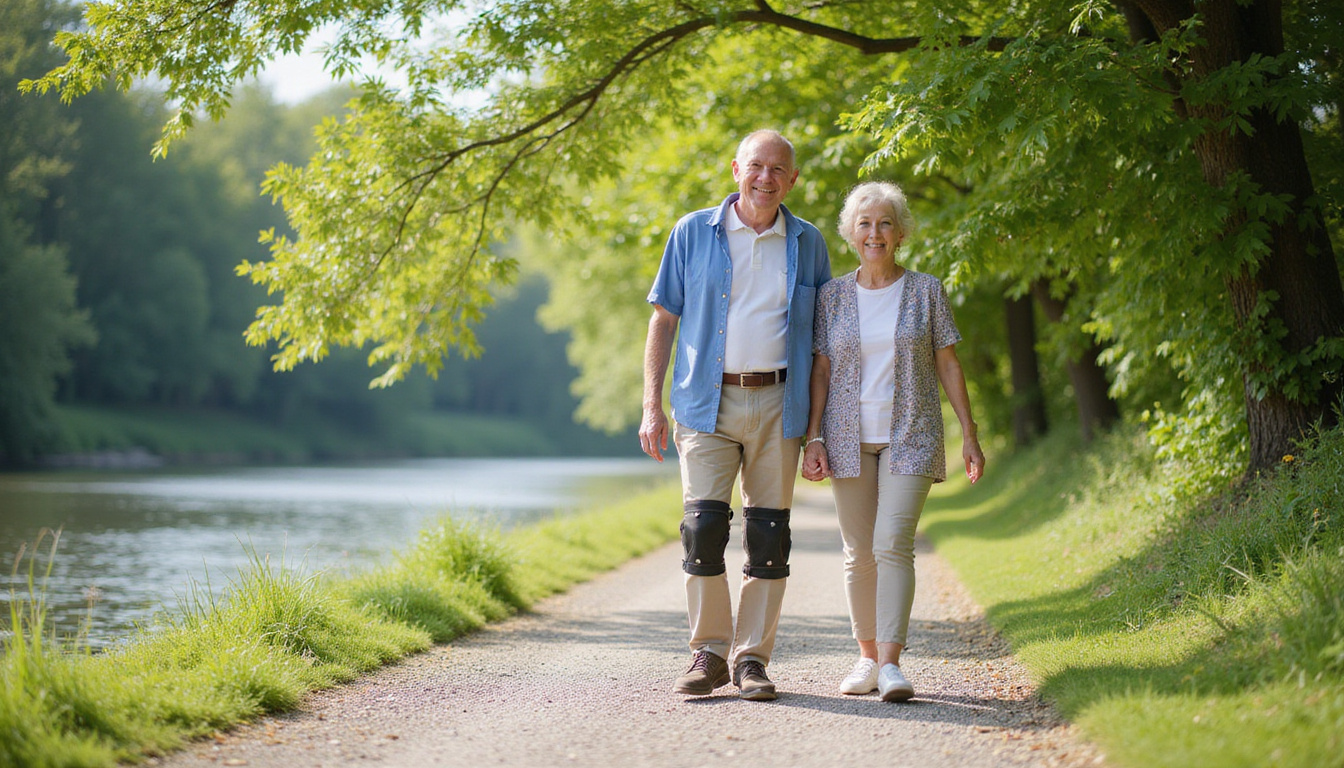
Knee sleeves or soft supports
• Some hikers wear light compression sleeves to give a sense of stability.
• They do not replace training or medical advice, but add extra comfort.
Trail strategy: how to hike smart with sore knees
Even the best knee friendly trail can hurt if your pace or style is off. Use a “joints first” plan.
Warm up before you leave the trailhead
Don’t step out of the car and run uphill hard. Instead:
• March in place a few moments.
• Do gentle body squats or leg swings near a bench.
• Walk the first 5–10 minutes slowly so your joints wake up.
A short warm-up helps your muscles take the load and protects your knees.
Take your time on the descent
Downhill is the danger zone for sensitive knees. Try to
• take short, controlled steps rather than long strides.
• lean slightly forward from your ankles, not your waist, to keep balance.
• use trekking poles to support yourself on steeper parts.
Listen for a soft twinge from your joints and adjust immediately instead of pushing on.
Breaks that actually help your joints
Rather than only sitting at viewpoints, try to
• take short standing breaks to rest your legs and reset your stride.
• pause on flat areas after a steep part so your joints can rest briefly.
These breaks not only help your breathing but also lower the joint stress.
Training off‑trail for stronger, happier knees
Many American hikers sit at desks or drive long hours. This can leave your hips, glutes, and core weak. When these muscles underperform, your knees must shock absorb and stabilize more.
Helpful off‑trail activities are:
• Strength work a couple of times a week: try body squats to a chair, step‑ups on a low step, and glute bridges.
• Light mobility sessions: do hamstring, quad, and hip flexor stretches or use a gentle yoga flow focused on the lower body.
• Gradual load progression: begin with flat walks, add pack weight slowly, then introduce hills instead of jumping to steep climbs.
Building strong muscles around your joints makes every hike easier.
Supplements and joint comfort: staying within smart limits
Many hikers try joint-support supplements as one tool among trails, good technique, and proper recovery. In the U.S., these supplements are not drugs. They are not meant to diagnose, treat, cure, or prevent any disease. They cannot replace care by a doctor.
When chosen wisely and taken as suggested, they support overall joint and muscle health. This can help you meet the demands of hiking. If you are interested in a supplement:
• talk with a healthcare professional first, especially if you use other medicines or have health conditions.
• choose products with clear ingredient lists and quality control.
• remember: nutrition, hydration, sleep, and solid training are the main supports.
The goal is to stack small advantages: smart trail choices, smart habits, and, if it fits, smart supplements.
For more on joint health with exercise, the CDC offers advice on staying active while protecting your joints (source: Centers for Disease Control and Prevention, cdc.gov).
Quick checklist: Is this a knee friendly trail for me?
Before you pick a hike, check for these items:
• Total elevation gain that your knees can handle
• No warnings like “brutal descent” or “relentless downhill” in recent reviews
• Trail surface that is mostly dirt, gravel, or duff as opposed to rocky steps and boulder fields
• Routes that go out‑and‑back or have loops with easy turn‑around points
• Mileage that suits your current fitness level
• Weather and trail conditions that do not make the route slippery
If a trail misses several of these points, save it for a stronger day and pick a gentler one.
FAQ: Knee friendly trails and gentle hiking
Q1: How do I find truly knee friendly trails near me?
Search for “easy loop,” “accessible trail,” “family-friendly hike,” and “nature trail” on local hiking websites and apps. Read recent reviews for mentions of “knees,” “joint friendly,” or “good for beginners.” National and state parks often mark their accessible and less strenuous options on maps.
Q2: Are shorter hikes always better for sore knees?
Not always. A 3‑mile hike can be steep and rocky. A 6‑mile rail-trail may be nearly flat. When you look for knee friendly hikes, check the total elevation gain, trail surface, and descent profile rather than focusing only on distance. Sometimes a longer, flat walk is easier on your joints than a short, steep one.
Q3: Can I backpack on knee friendly trails, or should I stick to day hikes?
Backpacking is an option if you keep pack weight light, manage your daily mileage, and watch your elevation. Increase the difficulty very slowly. Start with overnight trips on gentle, well-graded trails. Many long-distance trails have flatter parts that serve as gentle backpacking routes.
Why savvy hikers look at more than just the trail: Regenerix Gold
Skip a trip because you worry about your knees? Worry about missed hikes, medical costs, or lost work time? You think like a smart, risk-aware hiker. You consider the route, the weather, and your gear. You use that same mindset to support your joints and muscles. You want to keep on the trail today and protect your body for tomorrow.
That is where Regenerix Gold comes in. It is a supplement made for hikers and active people who want to support healthy joints and muscles. With Regenerix Gold, you can keep saying yes to sunrise starts, road trips, and stunning views. You do so without rolling the dice on your body or your work.
Regenerix Gold is not meant to diagnose, treat, cure, or prevent any disease. Yet it is designed for those who prefer to invest in proactive support instead of paying later with avoidable downtime.
If you see yourself as the hiker who picks the best line, carries the right gear, and thinks ahead about the true cost of being sidelined, consider adding Regenerix Gold to your routine. Use it along with knee friendly trails, smart training, and good recovery to keep moving toward the most active, fit version of your life.
Regenerix Gold
Health Note
Always consult a licensed medical doctor for your health issues.
Special Discount
If you prefer preventive nutrition to minimize expensive knee surgery and potentially addictive pharmaceuticals, Regenerix Gold is your savvy solution.
You qualify for a special discount.
Simply use the link below and a discount will automatically be applied during checkout.
Get Regenerix Gold => HERE


