
Pilates for scoliosis: Gentle Exercises to Improve Alignment and Strength
by Zestora on Jan 02, 2026

For many practitioners, Pilates for scoliosis means more than fitness. It becomes a way to move mindfully. You move, decompress, and feel more balanced in your body. In the studio you know your powerhouse and your posterior chain. Yet you may feel uneven load, tight muscles, or asymmetry. You are not alone. Pilates adapts to support your spinal curve. It focuses on alignment, controlled motion, and smart strength. It does this without forcing your body into “perfect” neutrality.
This guide speaks to Pilates practitioners in America who want to work with their curves, not against them.
Understanding Scoliosis Through a Pilates Lens
In Pilates, we use the terms axial elongation, segmental articulation, and three-dimensional breathing. Scoliosis challenges all these ideas. Your spine curves and rotates instead of aligning along one clean plumb line. This change affects how you:
• Bear weight through your feet, pelvis, and ribcage
• Use deep stabilizers instead of only global movers
• Define “straight” versus stacked in gravity
Pilates sees scoliosis as more than a curved spine. It becomes a pattern that shows:
• Uneven muscle strength and endurance
• Unbalanced fascial tension
• Changed proprioception (what feels centered may not be centered)
Your Reformer, Cadillac, Wunda Chair, and Mat serve as tools. They help you explore balanced loading and support. Do not force symmetry. Instead, aim for functional alignment.
Why Pilates for Scoliosis Makes Sense
When you approach Pilates with care, it can help you:
• Build postural awareness and a clear body map
• Strengthen your deep core (transversus, pelvic floor, multifidus)
• Enhance mobility in stiff parts without destabilizing flexible ones
• Evenly distribute work so one side does not overwork
• Strengthen your hips and shoulders to support your spine
Research shows that exercise focused on control, alignment, and breathing helps people with spinal curves (source: Hospital for Special Surgery).
Always work with your healthcare provider and a Pilates teacher who knows about scoliosis. This text does not replace professional care.
Foundational Principles: How to Modify Pilates for Scoliosis
Before you try advanced choreography on the Reformer, keep in mind the core principles for scoliosis-friendly Pilates:
1. Axial Elongation Over “Flattening”
Do not force the spine to lay flat. Instead, lengthen away from the mat:
• Let your head slide gently away from your tailbone.
• Grow tall through both sides of your waist—even if one side is naturally shorter.
• Decompress without jamming your ribs or pelvis for symmetry.
2. Three-Dimensional Breath
Your breath is a key ally:
• Direct your breath into the concave side of your ribcage.
• Embrace lateral and posterior breathing to ease tight spots.
• Exhale to support deep abdominals. Avoid gripping your upper rectus.
3. Smart Use of Props
Props help many with curves:
• Place yoga blocks or small balls under one side of the pelvis.
• Use rolled towels for extra support on the shorter side of your waist.
• Use straps and springs to assist rather than overload your dominant side.
4. Precision Over Big Moves
Slow down your movements:
• Reduce repetitions and lower your tempo.
• Focus on controlled movement through each joint.
• Keep the load even on both legs.
• Gently de-rotate your torso; do not force it.
Gentle Mat Pilates for Scoliosis: A Sample Sequence
This sequence is an idea bank. It is not one workout for everyone. Adjust it to your unique curve and comfort level.
1. Constructive Rest with Breath Mapping
Purpose: Reset, decompress, and sense your curves.
• Lie on your back. Keep your knees bent and your feet hip-width apart. Keep your arms by your sides.
• Place a folded towel under the side of your pelvis or ribcage that feels shorter.
• Inhale into your rib sides and back, focusing on the concave side.
• Exhale and imagine your spine lengthening from tail to crown.
Stay for 8–10 breath cycles.
2. Pelvic Clocks
Purpose: Enhance pelvic awareness and gentle motion.
• Lie on your back. See your pelvis as a clock.
• Rock to 12 o’clock (posterior tilt) and 6 o’clock (anterior tilt). Then rock to 3 and 9 o’clock.
• Move slowly and notice if one side feels stickier.
Do not force a full range. Keep the movement smooth.
3. Modified Shoulder Bridge
Purpose: Engage hip extension and segmental motion without stressing the back.
• Lie supine. Place your feet under your knees and keep your pelvis neutral if that feels good.
• Press into your feet as you inhale.
• Exhale and roll your pelvis off the mat, vertebra by vertebra.
• Pause where your ribs want to reach forward. Use your exhale to soften the move.
• Lower with control, articulating each segment.
If one leg feels overloaded, place that foot slightly forward or lessen its load.
4. Single Leg Knee Folds (Marching)
Purpose: Activate your deep core and stabilize your pelvis.
• Sit with a neutral spine and keep both feet on the mat.
• As you exhale, lift one knee to tabletop while keeping your pelvis level.
• Inhale and lower the leg slowly. Alternate between legs.
If one side of your pelvis hikes, use a folded towel for support and reduce the move’s range.
5. Side-Lying Series for the “Long” and “Short” Sides
Purpose: Balance the work for your hip and trunk.
• Lie on your side. Support your head and stack your hips.
• Lift the top leg to hip height, with a slight external rotation.
• Perform small leg lifts, lowers, and circles. Continue to keep your waist long (do not crunch).
On the side with the shorter curve, focus on length and lower intensity. On the longer side, build strength and support.
6. Quadruped Spinal Elongation
Purpose: Build weight-bearing alignment and axial length.
• Begin on your hands and knees.
• Spread your fingers and press into the floor, broadening your upper back.
• Inhale and lengthen your spine from your sit bones to your crown.
• Exhale and gently engage your deep abdominals. Avoid forcing a round back.
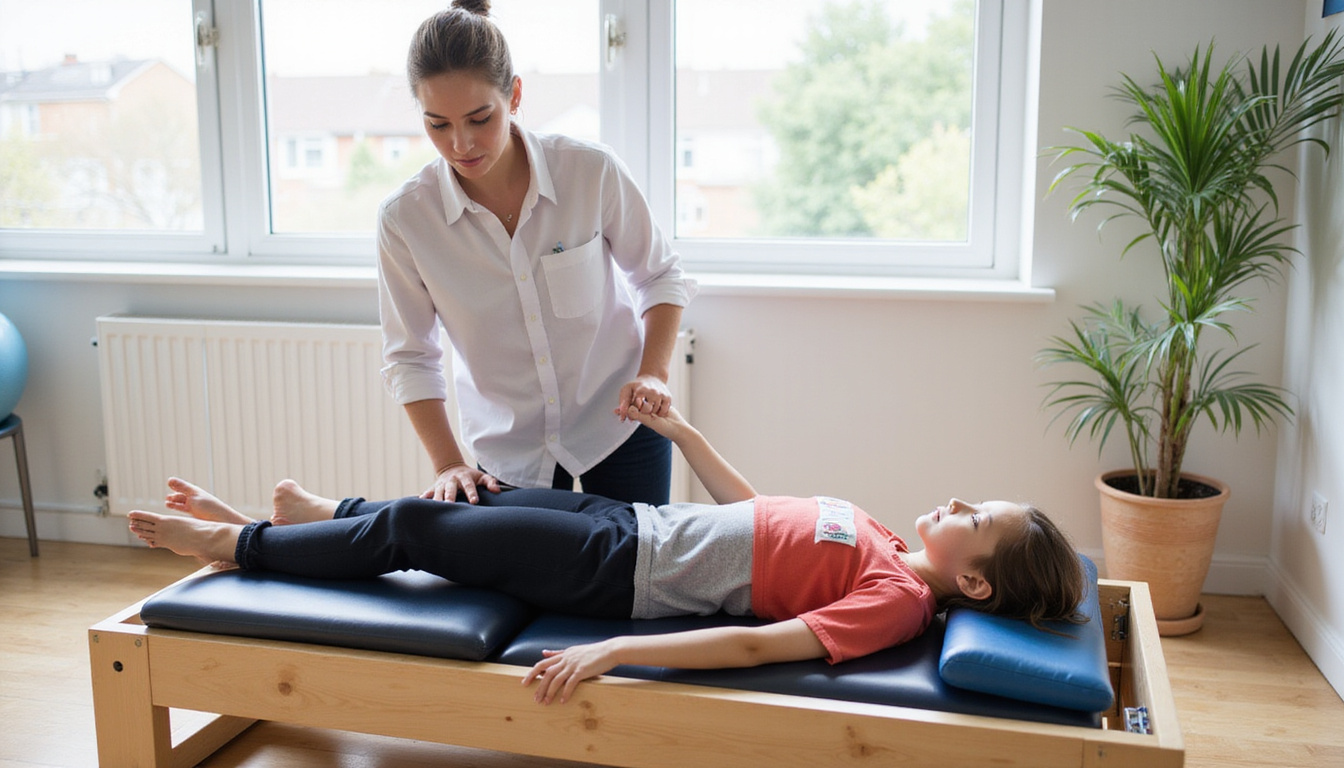
Option: Try an opposite arm/leg reach. Only if you can keep your pelvis stable without deepening your curve.
7. Mermaid with Support
Purpose: Improve lateral flexion and open tight lines.
• Sit in a comfortable cross-legged or Z-sit position.
• Support the shorter side of your pelvis with a block or bolster, if needed.
• Inhale and lift the arm on the concave side.
• Exhale and side-bend away, using your breath to ease tight ribs.
Keep the move gentle. Breathe into the curve instead of forcing more range.
How Apparatus-Based Pilates for Scoliosis Can Help
If you work on equipment, you know how much feedback springs and straps offer. For scoliosis, tools like the Reformer, Cadillac, and Chair can:
• Assist when gravity overwhelms you (for example, supported roll-downs on the Cadillac).
• Provide closed-chain work that improves your alignment awareness (for example, focus on even foot pressure on the Reformer).
• Allow asymmetric spring loading to reduce dominance on your stronger side.
Some examples include:
• Reformer Footwork: Watch for even heel and toe pressure and ensure your knees stay in line.
• Short Box Series (modified): Emphasize a gentle hinge and elongation over deep flexion.
• Standing Splits (supported): Work on hip stability and pelvic awareness while keeping your trunk organized.
If you feel more discomfort after using the equipment, reduce intensity, range, and spring tension. Then, check in with your instructor and healthcare provider.
Supporting Your Practice Nutritionally and Systemically
Pilates for scoliosis helps you build a body to support your everyday life. You need a body that carries your groceries, lets you sit comfortably at your desk, and supports you through routines and long days at the studio. Many practitioners also focus on:
• Sufficient protein to support muscles that work to stabilize you
• Good hydration, especially in a hot studio or after long sessions
• Micronutrients that support joints, connective tissues, and nerve function
Some Pilates lovers in America add dietary supplements for joint comfort and muscle support. Any supplement should:
• Be part of a balanced routine that includes movement, sleep, nutrition, and stress management
• Not replace professional care or customized rehabilitation
• Come from brands that are clear about their ingredients and quality tests
Practical Tips to Make Pilates for Scoliosis Safer and More Effective
Try these tips to fine-tune your practice:
- Work with mirrors and video. Visual feedback helps correct what feels off.
- Adjust your stance width. A slightly wider base may support your spine better.
- Begin with a warm-up. Start with breath work, pelvic clocks, and gentle motion before heavy loading or advanced moves.
- Avoid fatigue. When tired, your curve can worsen. Stop before form falls apart.
- Embrace asymmetrical setups. Adjust prop heights, spring tension, or stance width when needed.
- Check in after class. Notice how your back feels later and the next day. Adjust your practice as needed.
Quick Checklist: Are You Practicing Intelligently with a Curved Spine?
• Do I feel more decompressed and balanced after class rather than tense and strained?
• Do I intentionally use my breath on the concave side?
• Do I feel my deep core working, not just my superficial muscles?
• Am I willing to look slightly asymmetrical to feel truly aligned inside?
If you answer “yes” to most, you are on a constructive path.
FAQ: Common Questions About Pilates and Scoliosis
-
Is Pilates safe for beginners with scoliosis?
Yes. Pilates can be adapted for people with spinal curves. Beginners can start with basic mat work that focuses on breath and alignment. Always consult your healthcare provider before starting a new routine. -
What are the best Pilates exercises for scoliosis and core support?
Gentle moves that emphasize axial elongation and deep core work are favored. Examples include pelvic clocks, supported bridges, modified abdominal work, and side-lying hip work. The best exercises vary by individual and should leave you feeling balanced and controlled. -
Can Pilates help with back tightness and uneven muscles due to scoliosis?
Many people report that regular Pilates helps manage tightness and build balanced strength. By improving posture, breathing, and controlled movement, Pilates may lead to everyday comfort. Always work with a qualified teacher who can modify exercises for your needs.
Why Savvy Pilates Practitioners Choose Regenerix Gold
You invest time and money to keep your body aligned and functional. In a world of high healthcare costs and lost work time, it makes sense to think long-term. Many experienced practitioners add a high-quality supplement to complement their Pilates routine.
Regenerix Gold supports healthy joints and muscles. It helps you keep doing what you love—whether teaching, practicing, or moving through your day—without waiting for pain or injury to force a break.
Choosing a premium supplement is also a smart financial decision. Investing in your musculoskeletal health now can be much less expensive than facing missed work, copays, and long rehab later. If you take a proactive approach to your health, consider adding Regenerix Gold to your daily regimen. This works best alongside your personalized Pilates practice, thoughtful nutrition, and recovery strategies.
Regenerix Gold
Health Note
Always consult a licensed medical doctor for your health issues.
Special Discount
If you prefer preventive nutrition to minimize expensive knee surgery and potentially addictive pharmaceuticals, Regenerix Gold is your savvy solution.
You qualify for a special discount.
Simply use the link below and a discount will automatically be applied during checkout.
Get Regenerix Gold => HERE


