

For many practitioners, yoga for fibromyalgia is more than exercise. It becomes a lifeline. When your body feels spent—even before you unroll your mat—typical flows seem impossible. Yet you do not want to give up yoga or lose your identity as “the yoga person.” You need a new approach. One respects your nervous system, cares for your muscles and joints, and still brings comfort after savasana.
Below is a guide for practitioners. It shows how to bring gentle yoga into life with ongoing muscle and joint pain. You will find simple ideas to match your body and energy cycles.
────────────────────────────
Rethinking yoga when your body is always “on high alert”
When you live with widespread tenderness, stiffness, and exhaustion, your body stays in stress mode. Standard cues, like “go to your edge” or “feel the burn,” may hurt more than help. Your practice now must:
• Calm an over-alert system
• Nurture joints and fascia without overloading them
• Balance gentle movement with needed rest
This method is nervous-system-centric yoga. It is less about a perfect handstand and more about creating a space where your muscles and joints feel safe enough to soften, stretch, and move.
────────────────────────────
Principles of yoga for fibromyalgia‑friendly practice
Before you try sequences, root your practice in these ideas:
1. Gentle over “strong”
Forget the idea of “no pain, no gain.” Your body thrives when you use:
• Small motion ranges
• Slow, careful transitions
• Short holds with plenty of support
You are not “less of a yogi” when you choose gentleness. You are being smart.
2. Pacing, not pushing
Pacing is a key skill. In practice, this means you can:
• Use short sessions (10–25 minutes) several times a week
• Do one or two stable poses instead of a long flow
• Stop a sequence if your body says “enough”
3. Sensation as your teacher
Listen to your inner signals:
• Green‑light sensations: a mild stretch, light warmth, easy breathing
• Yellow‑light cues: a sharp pull, rising tension, or short breaths
• Red‑light signs: burning, stabbing pain, sudden fatigue, dizziness, or anxiety
Stay safely within the green. Test the yellow edge only briefly. Step back if you hit red.
────────────────────────────
Morning reset: a 10‑minute floor sequence
This short sequence helps on days when rising is hard. Use a mat or soft carpet, move slowly, and keep your effort gentle.
-
Supine Belly Breath (3–5 minutes)
• Lie on your back with bent knees. Keep your feet wider than your hips.
• Rest your hands on your belly.
• Inhale through your nose and feel your belly lift. Exhale with a slow sigh.
• Let your back melt into the mat. -
Knee‑to‑Chest Rock (1–2 minutes)
• Hug one knee toward your chest. Keep the other leg relaxed.
• Rock slowly from side to side while massaging your lower back.
• Switch sides gently. -
Supported Figure‑4 (2–3 minutes total)
• Place your right ankle across your left thigh to form a “4.”
• Option 1: Slide a bolster or pillow under the left thigh.
• Option 2: Hold the back of your left thigh.
• Keep your jaw soft and shoulders low. Take 6–8 slow breaths, then change sides. -
Mini Bridge with Support (2–3 minutes)
• Keep your feet under your knees and hip‑width apart.
• Slide a block or firm pillow under your sacrum.
• Rest in a gentle supported bridge without active lifting.
• Focus on filling the back of your lungs with each inhale. -
Resting Twist (2 minutes)
• Bring your knees to your chest. Slowly drop them to one side.
• Rest your arms in a T or cactus shape.
• Use a pillow under or between your knees.
• Take 6–8 slow breaths, then roll onto your side and rise slowly.
This mini-practice eases morning stiffness. It tells your muscles that they are safe, setting a calm tone for the day.
────────────────────────────
Midday micro‑flow: keeping joints and fascia fluid
Long hours sitting or standing can build tension. A short, gentle flow helps without draining you.
Aim for 8–15 minutes, 3–4 days per week:
Gentle cat‑cow at the wall or table
If you find hands-and-knees positions hard, use a counter or sturdy table:
• Place your hands on the surface and step back slightly.
• Inhale: soften your knees. Let your heart move forward. Lift your tailbone a bit.
• Exhale: round your upper back. Soften your gaze. Tuck your tail gently.
• Do 8–10 slow rounds, guided by your breath.
Modified sun salutation (chair‑based)
- Sit at the edge of a chair with your feet on the ground.
- Inhale: sweep your arms up, or halfway if that feels enough.
- Exhale: bend forward so your forearms rest and your head grows heavy.
- Inhale: lift your spine so it lengthens, and rest your hands on your thighs.
- Exhale: ease and round your back slightly.
- Return upright and repeat 3–5 times.
You are not chasing sweat. You invite gentle blood flow to your muscles and joints.
────────────────────────────
Evening wind‑down: practices to ease pain and fatigue before sleep
Often, pain and fatigue peak at night. An evening practice that calms your nervous system may help.
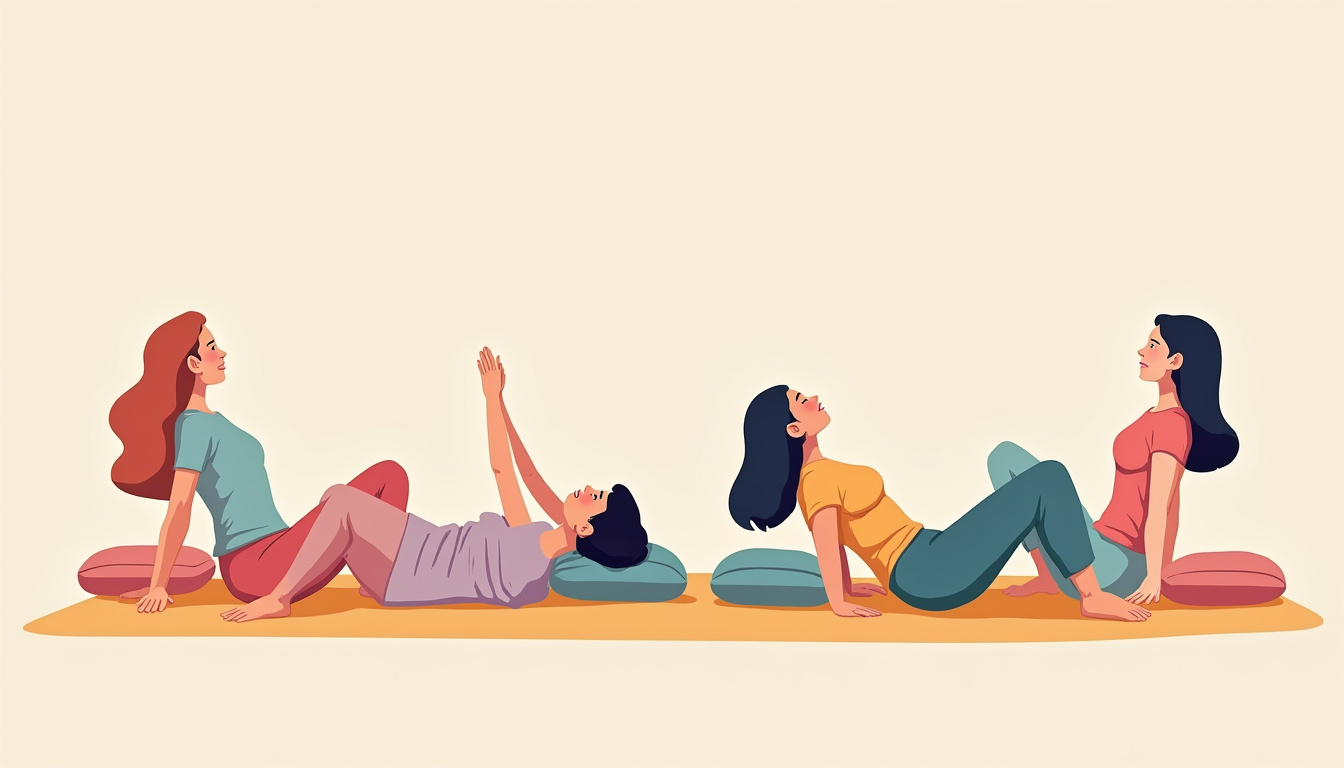
Legs up the couch
• Sit sideways at the end of a couch.
• Swing your legs up so that your calves rest on the cushions. Lay your upper body on the floor (or on mats/blankets).
• Support your head and neck with pillows.
• Rest for 5–10 minutes, breathing into your back ribs.
This simple inversion lifts heaviness from your legs and soothes your system gently.
Supported child’s pose (fully propped)
• Kneel and place a bolster or stacked pillows lengthwise between your knees.
• Fold forward so your torso and head rest on the support.
• If needed, add extra cushions under your hips or ankles.
• Breathe slowly into your back, taking 10–20 breaths.
If kneeling feels hard, try placing a pillow on a table and rest your torso forward for similar ease.
────────────────────────────
Props are not cheating: they’re intelligent
Using props in yoga for fibromyalgia helps you feel nourished instead of strained:
• Bolsters and firm pillows support your torso or legs.
• Blocks or sturdy books help bring the floor closer in forward folds.
• Straps or scarves let you reach gently for hamstring or shoulder work.
• Blankets pad your knees and ankles, and help keep your body warm.
Think of props as a soft message to your nervous system: “You are held. You do not need to brace.”
────────────────────────────
When to dial back—and when to skip the mat
Your inner drive may urge you to push on. Listen closely to your body, especially on high‑symptom days.
• Dial back if you notice a small increase in tenderness or stiffness after a few poses.
• Slow your breath, or feel your jaw clench and shoulders rise.
• Skip or shorten your practice if:
– You face a significant flare-up of discomfort.
– You feel flu‑like exhaustion or dizziness.
– Your sleep has been disrupted for many nights.
On those days, 3–5 minutes of deep breathing or one supported pose can help more than a full sequence.
────────────────────────────
Nourishing your joints and muscles from the inside out
Your yoga mat is not the only place to care for your body. Your joints, muscles, cartilage, and fascia need:
• Adequate water
• Enough high‑quality protein
• Micronutrients to support collagen, joint comfort, and muscle repair
Some nutrients, like specific collagen types, antioxidants, and phytonutrients, can work with movement and a balanced lifestyle to support joint health (source: National Center for Complementary and Integrative Health).
No supplement can cure a medical condition. Yet many practitioners in America add targeted formulas to their self‑care. Their routine includes:
• Gentle, regular movement
• Mindful stress management
• Good sleep habits
• Working with trusted health professionals
If you consider a supplement, use a trusted brand. Read labels and talk to your healthcare provider—especially if you take medicine or have other health issues.
────────────────────────────
Regenerix Gold
For those serious about a long‑term practice, a joint and muscle support supplement like Regenerix Gold may fit well in your routine. You do not wait until pain forces you off the mat. Instead, some yogis choose to support joint function, cartilage, and muscle recovery early on. This is important if you wish to keep teaching, working, or caring for family without fearing what your body might do next.
Regenerix Gold suits those who invest in their health. Consider the costs of missed work, extra medical appointments, or lost chances when your body slows down. Preventive care may be the smarter choice. It is the difference between reacting all the time and designing a practice‐friendly life.
If you are a yoga practitioner in America who wants to move gracefully, protect your joints and muscles, and not let physical limits control your life, talk with your healthcare professional. Ask if a joint and muscle support formula like Regenerix Gold might be a sound addition to your self‑care.
────────────────────────────
FAQ: yoga for fibromyalgia‑style practice
1. Is yoga good for fibromyalgia‑type pain and fatigue?
Gentle yoga may support people with widespread muscle and joint pain and fatigue. Slow sequences, restorative poses, and mindful breathing can relax you, ease movement, and help you feel at home in your body. The key is low intensity, many props, and avoiding a “push through the pain” mindset.
2. What kind of yoga is best for fibromyalgia‑like symptoms?
Styles that emphasize rest and calm work best. Restorative yoga, yin‑inspired holds (very gentle), mild hatha, and chair yoga are good choices. Fast vinyasa or hot classes can stress already sensitive tissues. Create a toolkit of 5–10 favorite moves that you can change with your energy level.
3. How often should I do yoga for fibromyalgia‑related joint and muscle discomfort?
Regularity helps more than long sessions. Many people do best with short sessions of 10–20 minutes, 3–6 days a week. Adjust your time on high‑symptom days. Always listen to your body. If you are unsure about balancing movement and rest, check with a healthcare professional.
Health Note
Always consult a licensed medical doctor for your health issues.
Special Discount
If you prefer preventive nutrition to minimize expensive knee surgery and potentially addictive pharmaceuticals, Regenerix Gold is your savvy solution.
You qualify for a special discount.
Simply use the link below and a discount will automatically be applied during checkout.
Get Regenerix Gold => HERE


