

When you hit steep switchbacks or climb shale sidehills, your knees bear the strain.
When you trudge a dark ridge with a heavy pack, your knees feel that strain too.
If you recover from a tweak, strain, or blowout, smart ACL support makes the difference between getting back to the trail and staying home with your phone.
This guide shows simple strength moves and nutrition tips so your knees feel stronger, stable, and ready for the trail.
Why ACL support matters for hunters and hikers
Hunters and hikers live for elk bugles, turkey gobbles, and long thru-hikes.
Your knee must stay stable.
Each move in the field loads your ACL, for example:
- You side-hill with a full pack.
- You drop into draws then climb out.
- You scramble over deadfall.
- You pivot fast to take a shot or to avoid a slip.
- You descend loose scree, mud, or snow.
Even if your healthcare provider clears your knee, your muscles and ligaments can feel unsteady under a pack.
Targeted ACL support training and smart nutrition help you stay sure-footed, without needing to ease every step.
Ground rules before you start strengthening
Before you begin ACL support work, keep these points in mind:
- Get clearance from a healthcare professional first.
- Mild muscle fatigue is fine; sharp or worsening knee pain is a red flag.
- Progress slowly—imagine adding weight gradually over a season.
- Train both legs, even if only one feels “iffy.” This practice prevents imbalance.
Think of these moves as scouting for weaknesses, then building strengths.
Simple strength moves that build real-world ACL support
Your goal is stability and strength that work on the trail.
These exercises suit hikers with a load, hunters in rough country, and anyone covering long miles on uneven ground.
1. Wall sits: pack-out endurance for your quads
Wall sits build your thigh strength without pounding your knees.
They put controlled tension in your muscles, similar to braking on a descent.
How to do it
- Stand with your back against a wall and feet shoulder-width apart, 1–2 feet away.
- Slide down until your knees form about a 90-degree angle (or slightly less if needed).
- Keep your knees above your ankles without caving in.
- Hold for 20–45 seconds, rest, and repeat 3–4 times.
Trail benefit:
It simulates the controlled muscle tension you need during long descents with a pack.
2. Step-ups: simulate climbing with a pack
Step-ups mimic real-world steps and help ACL support.
The move works your leg muscles through a natural climbing path.
How to do it
- Use a sturdy bench, box, or low stair.
- Step up with your “problem” leg first, driving through the heel.
- Fully straighten your knee and hip at the top.
- Step down carefully; do not crash down.
- Do 8–12 reps per side and 2–3 sets.
Tips
- Keep your knee tracking over your second or third toe.
- When the move becomes easy, add weight with a pack or dumbbells.
Trail benefit:
It preps your knee for climbing rock ledges and steep trails with gear.
3. Mini-band walks: protect the knee from “caving in”
Strengthening hips and glutes is key to ACL support.
These muscles help when you face sidehills, off-camber trails, or loose ground.
How to do it
- Wrap a resistance band around your legs just above your knees or at your ankles.
- Hinge slightly at your hips and bend your knees to form a mini squat.
- Step sideways while keeping toes forward and knees steady.
- Take 10–15 controlled steps each way, for 2–3 rounds.
Trail benefit:
This drill keeps your knees aligned on sidehills, uneven rocks, and shifting terrain.
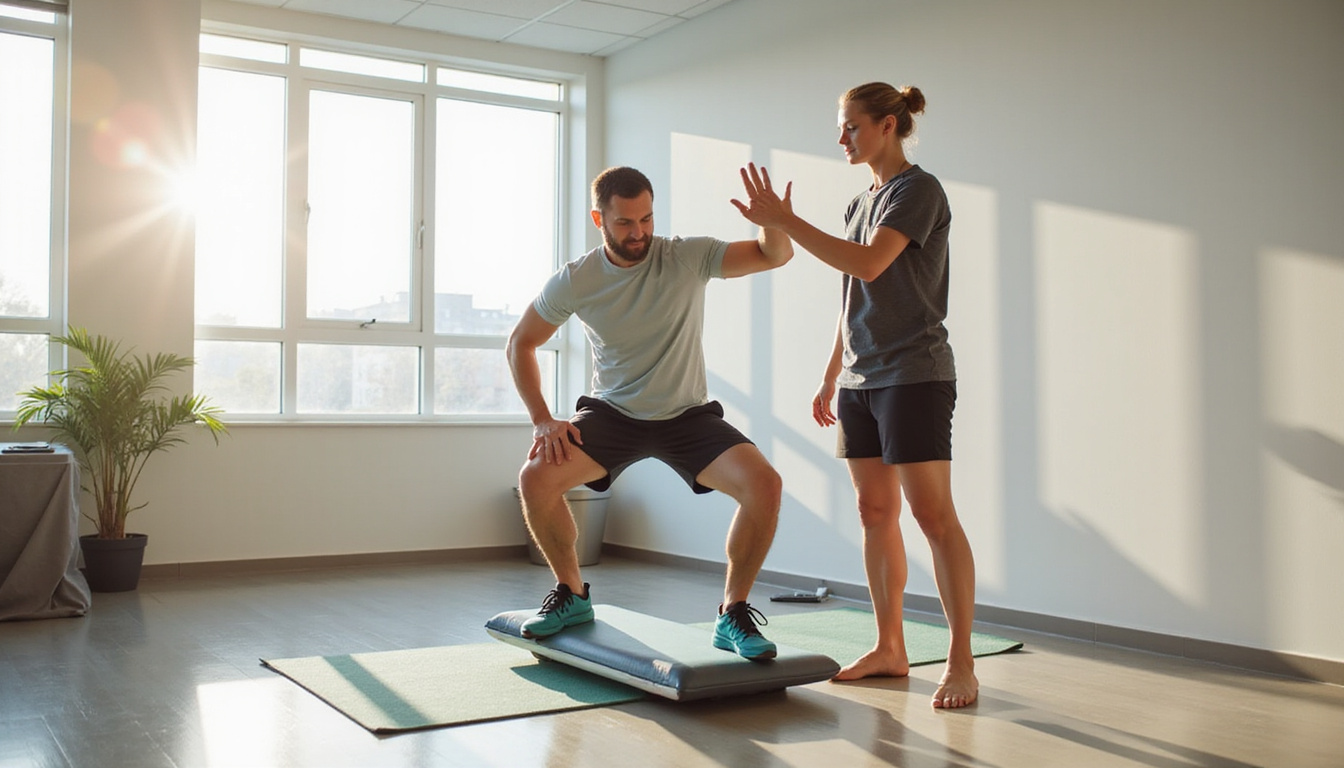
4. Single-leg balance: train for unstable ground
If you slip on wet leaves or loose shale, you know balance matters.
This move trains your knee to react fast on uneven ground.
How to do it
- Stand on one leg with the knee slightly bent.
- Hold the pose for 20–30 seconds without support.
- To make it harder, close your eyes, stand on a folded towel, or move your other leg.
- Do 2–3 rounds per leg.
Trail benefit:
It builds reflexes and small adjustments, so your knee responds quickly when challenged.
5. Heel-elevated calf raises: unlock ankle mobility and knee comfort
Tight calves and stiff ankles force awkward knee moves.
This exercise frees up your ankle and eases knee mechanics.
How to do it
- Stand on a step or board with your heels hanging off the edge.
- Hold onto a railing or wall if needed.
- Rise onto your toes, pause, then slowly lower your heels below the step.
- Aim for 15–20 reps and 2–3 sets.
Trail benefit:
Improved ankle motion makes your knee movement smoother on hills.
6. Supported split squats: build front-to-back leg stability
Split squats work like controlled lunges for good knee support.
They build balance between your front and back legs.
How to do it
- Stand in a staggered position: one foot forward and the other back.
- Hold a chair, wall, or pole with one hand for support.
- Lower slowly by bending both knees, keeping your front knee in line with your toes.
- Lower as far as comfortable.
- Push up mainly through the front heel.
- Do 8–10 reps per leg, 2–3 sets.
Trail benefit:
This exercise trains the leg angles you use on uneven rocks and ledges.
Weekly ACL support game plan for hunters and hikers
You do not need a gym to support your knees.
Follow this 3-day plan and adjust based on your knee’s signals.
3 days per week (non-consecutive):
-
Warm-up:
- 5–10 minutes of brisk walking or light cycling
- Gentle leg swings and hip circles
-
Strength circuit (2–3 rounds):
- Wall sits: hold for 20–45 seconds
- Step-ups: 8–12 reps per leg
- Mini-band walks: 10–15 steps in each direction
- Heel-elevated calf raises: 15–20 reps
- Supported split squats: 8–10 reps per leg
- Single-leg balance: 20–30 seconds per leg
-
Cooldown:
- Stretch quads, hamstrings, and calves lightly for 20–30 seconds each
Think of this plan as off-season scouting for your body.
Consistent small moves make a big difference when you hit the trail.
Smart recovery: what to do after knee-heavy days
After a long hike or a heavy day in the field, recovery is important.
A proper routine helps reduce stiffness and builds strength.
- Ease into activity after hard days with light walking, gentle motion, or easy cycling.
- Use cold and heat wisely: short cold treatments (ice packs or cold water) followed by gentle warmth can ease discomfort.
- Prioritize sleep because muscles and tissues heal best during rest.
(Source: National Institutes of Health)
Nutrition, joint health, and ACL support
No supplement replaces strong training or medical advice.
But for hunters and hikers, nutrition can support healthy knees and muscles.
A balanced diet often includes:
- Enough protein to maintain muscle
- Healthy fats from fish, nuts, and seeds
- Adequate hydration during long outdoor days
- Vitamins and minerals that help connective tissues work normally
Regenerix Gold: nutrition-based knee support for field-going folks
For extra nutritional support for healthy joints and muscles, many choose Regenerix Gold.
Regenerix Gold
Here’s what it does for ACL support:
- It offers nutrition-based knee support and is not a drug or medical treatment.
- Some doctors and physical therapists recommend it for joint comfort and muscle function.
- It has been used for over a decade, with global reviews from active people who hike, climb, and carry heavy packs.
- It supports healthy joints and muscles, especially when you log long miles or spend long days on your feet.
Always remember: Supplements like Regenerix Gold do not diagnose, treat, cure, or prevent any disease.
They only support a broader plan that includes strength training, proper technique, the right gear, and medical advice if needed.
Gear tweaks that make ACL support easier on the trail
Good gear matters for your knees just as much as it does for your eyes.
Respect your knees as you respect your pack or glasses.
- Trekking poles act as extra legs on steep descents or uneven ground.
- Boots with the right stiffness help your knee work efficiently.
- A well-adjusted pack prevents extra knee stress.
- Smart pacing—shortening your stride and slowing on steep or loose ground—protects your knees.
These small tweaks, combined with strength moves and smart nutrition, help your ACL feel well-supported when it matters most.
FAQs about ACL support for people who hunt and hike
Q1: What’s the best way to build ACL joint support without a gym?
A: Use bodyweight exercises like step-ups on a sturdy bench, wall sits, mini-band walks, and single-leg balance drills. They mimic the motions on uneven trails and steep hills.
Q2: Can supplements help with ACL knee support for active outdoorsmen?
A: Supplements do not fix an injury or replace rehab.
They support healthy joints and muscles alongside training.
Products like Regenerix Gold offer nutrition-based support for active people.
Always check with your healthcare provider before starting any supplement.
Q3: How long does it take to feel stronger ACL muscle support after starting these exercises?
A: Improvements may come within several weeks.
Most people notice better balance and confidence within 6–12 weeks of steady training.
Think of it as a full pre-season for your body.
Locking in your advantage: why now is the time to act
You invest in tags, fuel, optics, and boots.
Your knees deserve that same care—because medical bills, lost time, and long rests cost dearly.
Start a simple, consistent routine that includes strength moves, recovery, and even nutrition-based support like Regenerix Gold.
This plan gives you an edge:
- You can tackle an extra ridge instead of turning back.
- You are less likely to hesitate on a tricky descent when an opportunity comes.
- You show the same planning with your body as you do with your gear.
If you value staying in the game for many seasons, act now.
Consider a bottle of Regenerix Gold along with this strength plan.
It is a small, proactive step to help you control your body, protect your livelihood, and avoid the heavy cost of being sidelined when you want to be out on the trail.
Health Note
Always consult a licensed medical doctor for your health issues.
Special Discount
If you prefer preventive nutrition to minimize expensive knee surgery and potentially addictive pharmaceuticals, Regenerix Gold is your savvy solution.
You qualify for a special discount.
Simply use the link below and a discount will automatically be applied during checkout.
Get Regenerix Gold => HERE


