
chronic pain yoga: gentle routines to reduce pain and restore mobility
by Zestora on Dec 21, 2025

For many dedicated practitioners in America, chronic pain yoga is more than a trend—it is a lifeline. When nagging hips, stiff shoulders, or a low back block your asana, your mat can feel like an enemy. With a gentle, smart, and joint‑aware approach, yoga becomes a tool to ease pain and restore movement.
This guide speaks to experienced and new yogis who feel musculoskeletal strain, tension, or persistent aches. It offers a practice that helps and does not hurt the body.
Rethinking “No Pain, No Gain” On the Mat
Many Western yogis bring their fitness mindset into yoga. They assume that a deeper stretch makes a better pose and that sweat marks success. For bodies that hurt, that idea can worsen pain in joints, fascia, and muscles.
If you explore chronic pain yoga, shift your inner story:
- Instead of asking, “How far can I go?”
ask, “How well can I support my joints?” - Instead of thinking, “I should match the teacher or the class,”
say, “I honor my unique alignment and range today.” - Instead of telling yourself, “Push through,”
whisper, “Stay just below discomfort and let your body feel safe.”
This method sends a clear message to your nervous system. It makes chronic pain yoga a practice you can keep for the long run.
The Science Behind Gentle Yoga for Ongoing Pain
Studies show that mindful movement, like yoga, can help by:
- Keeping joints more flexible
- Balancing and coordinating muscles
- Making you more aware of your body so you do not overload one spot
- Calming your stress response and helping you sleep, which in turn affects pain
A review in the Annals of Internal Medicine found that yoga can work as well as standard exercise to improve back function in adults with persistent back pain (source: Annals of Internal Medicine).
Remember, yoga is not a cure or a treatment. It cannot diagnose or prevent disease. Gentle and steady yoga, however, can add strength to your overall wellness plan.
Principles of Chronic Pain Yoga for Practitioners
Before you begin any sequence, ground your practice with these ideas:
-
Work at 60–70% intensity.
Remain within a safe zone. If 100% means pushing to the deep edge, try 60–70%. The aim is to protect your nervous system, not to show off a perfect pose. -
Favor stability over full range.
Build strength around the joints that support you. Keep a small bend in the knees, engage the shoulders lightly, and avoid letting the low back drop too far. -
Move slowly and breathe audibly.
Use Ujjayi breathing or a gentle nasal breath. If your breath turns rough or stops, you are pushing too hard. -
Choose pain‑free shifts.
The way you enter and exit a pose matters. Use props, move in small steps, and avoid any sudden changes. -
Add “recovery days” on the mat.
Yin or restorative sessions with supports are as valid as dynamic vinyasa days. They help when pain shows up.
A Gentle 20–30 Minute Chronic Pain Yoga Flow
Use this sequence when your body feels stiff, achy, or worn out. Keep the motions slow and listen for any sharp or rising pain. All poses are ideas; change them if needed.
1. Grounding and Breath (3–5 minutes)
- Constructive Rest: Lie on your back. Bend the knees widely, and let them rest close together.
- Place one hand on your belly and the other on your heart.
- Take 10–20 slow breaths. With every inhale, let your ribcage grow; with every exhale, relax further.
This practice opens your low back and signals to your nervous system: you are safe.
2. Joint-Friendly Warm-Up (5–7 minutes)
Move slowly, always staying inside your personal edge.
-
Pelvic Tilts (Supine Cat-Cow):
• Lie on your back. Inhale slowly to lift your tailbone a bit.
• Exhale to press your low back into the mat.
• Do 8–10 rounds. -
Knee Hugs to Circles:
• Hug one knee as far as is comfortable.
• Make small circles with that knee to open the hip.
• Do 5–8 circles each way with each leg. -
Supine Windshield Wipers:
• Keep feet at mat width and knees bent.
• Gently sway your knees from side to side. Stay within a small, comfortable range.
These warm-ups prepare your joints before you stand up.
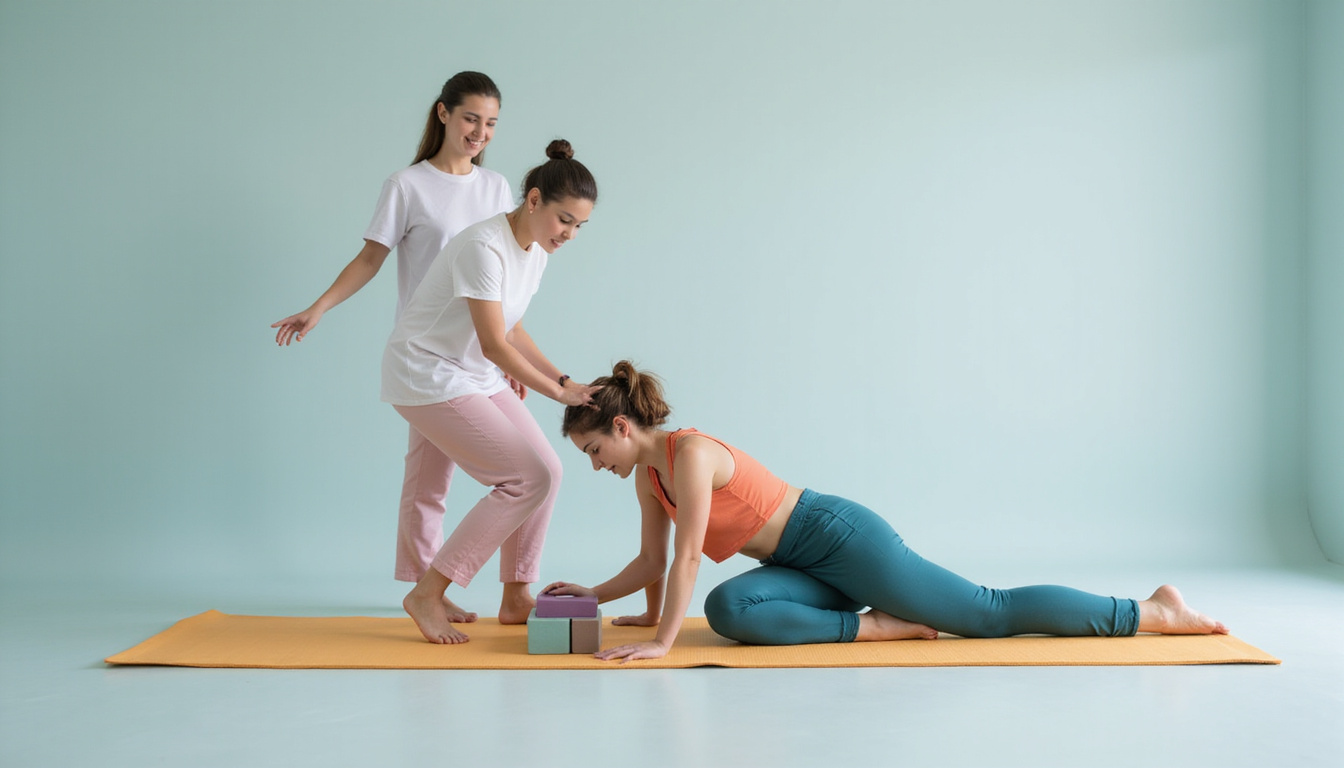
3. Supported Cat-Cow and Thread the Needle (5 minutes)
Come to all fours. Keep your wrists under the shoulders and your knees under the hips. Add a blanket under the knees if needed.
-
Cat-Cow (Tabletop):
• Inhale to soften the belly and widen the collarbones.
• Exhale to round the spine and press the floor away.
• Do 8–10 rounds. Focus on smooth, safe motion. -
Thread the Needle (Supported):
• From all fours, slide the right arm under the left side. Rest the shoulder and head on a block or cushion.
• Keep your hips steady. Adjust if there is any pinching feeling.
• Hold for 5–8 breaths on each side.
This part gently frees up your spine and shoulders.
4. Standing Flow with Support (5–7 minutes)
Stand near a wall or chair for balance. There is no need for a dramatic expression; the goal is ease.
-
Chair-Assisted Mountain to Half Forward Fold:
• Stand behind a sturdy chair and hold the back for support.
• Inhale: lift your crown, soften the knees, and lengthen your spine.
• Exhale: hinge at the hips into a half fold. Keep your core engaged and your spine long.
• Repeat 5–8 rounds. -
Supported Warrior I/II (Short Stance):
• From standing, step one foot back into a shorter lunge. Keep the front knee gentle.
• Hold onto a chair, wall, or blocks.
• Try a gentle external rotation for Warrior II, then return to neutral.
• Hold each side with 3–5 breaths.
This flow builds gentle strength and balance with the help of props.
5. Hip and Low-Back Release on the Mat (5–7 minutes)
-
Supported Figure Four:
• Lie on your back. Cross the right ankle over the left thigh.
• Instead of pulling the leg close, keep both feet on the mat. Rock gently side to side.
• For less intensity, slide the standing foot farther away.
• Hold for 8–10 breaths on each side. -
Supine Twist (Small Range):
• With knees bent and feet on the mat, drop both knees a few inches to one side.
• Keep your shoulders flat on the mat.
• Stay within a small rotation.
• Hold for 5–8 breaths on each side.
These poses ease the tension from hips and low back, with very little twist in the spine.
6. Restorative Finisher (5–10 minutes)
-
Legs on Chair or Couch:
• Lie flat on your back. Rest your calves on a chair so that your knees form a 90-degree angle.
• Support your head and neck. If needed, place a folded blanket under your hips.
• Close your eyes, relax your jaw, and rest for 5–10 minutes.
This final pose gently takes pressure off your lumbar spine and supports blood flow in the legs. It tells your body to rest and heal.
Prop Hacks for Pain-Smart Yogis
Props do not show weakness. They are the marks of a wise and experienced practitioner. In chronic pain yoga, props are friends:
-
Blocks:
• Use for hand support in forward folds and lunges.
• Place between the thighs in Bridge to help engage inner legs and protect the low back. -
Bolsters and Pillows:
• Put under your knees in Savasana to ease the lower back.
• Use along your spine in a heart opener instead of deep backbends. -
Straps:
• Wrap around your feet in hamstring stretches to keep your spine neutral. -
Blankets:
• Provide cushioning under knees, wrists, or sit bones to support a neutral position.
When Your Yoga Practice Might Be Contributing to Pain
Sometimes, advanced habits can stress your joints. Notice these signals:
- You feel more pain after class than before.
- You chase extreme range without enough strength (for example, deep splits or backbends that hang in the joints).
- You move too quickly between poses and catch yourself only at the end.
- You miss out on Savasana and do not allow time for your body to settle.
If you see these signs, remember that slower moves, prop support, and smart load management can help you reshape your practice.
Daily Micro-Practices to Support Your Joints
You do not need a long session every day. Add these joint-friendly habits to your routine:
- Stand up and gently move your spine every 60–90 minutes.
- Do 5–10 slow neck and shoulder rolls between Zoom calls.
- Take 3 slow belly breaths before getting out of bed and before sleep.
- Use a wall to support a short Half Forward Fold for 1–2 minutes during your workday.
Quick List: Do’s and Don’ts for Chronic Pain Yoga
-
Do: • Use props generously.
• Keep your breath smooth and even.
• Inform your teacher if you feel joint or muscle pain.
• Choose strength and stability over reaching extreme depth.
• End each practice with a time of rest. -
Don’t: • Force shapes that cause sharp pain.
• Compete with anyone in the class.
• Skip your warm-up or cool-down.
• Hold your breath to push through a pose.
• Believe that extra sensation always means progress.
Supporting Your Muscles and Joints Beyond the Mat
Many devoted practitioners know that what you do off the mat affects how you feel on it. Along with good sleep, proper hydration, and a balanced diet, many yogis add high-quality joint and muscle support supplements to their day.
Any supplement should be part of a healthy lifestyle that includes:
• Mindful movement (gentle vinyasa, restorative, or chronic pain yoga flows)
• Attention to posture and ergonomics
• Regular periods of rest and recovery
Supplements cannot diagnose, treat, cure, or prevent disease. If you have ongoing pain or serious limitations, talk to a health professional before you make any changes.
Video: Regenerix Gold for Joint and Muscle Support
Regenerix Gold
FAQ: Chronic Pain Yoga and Joint-Friendly Practice
Q1: Is chronic pain yoga safe for tight hips and a sensitive low back?
Yes. When done mindfully, chronic pain yoga uses small ranges of motion, gentle strength moves, and plenty of props. Avoid any pose that triggers sharp pain and ask a health professional for advice.
Q2: How often should I practice yoga for chronic musculoskeletal discomfort?
Many find that 3–5 sessions a week that last 15–30 minutes work better than occasional long, intense classes. A regular low- to moderate-intensity practice is kinder to the joints.
Q3: Can a chronic pain yoga routine replace physical therapy or medical care?
No. Yoga is a supportive practice and cannot replace personalized medical or therapeutic care. It can enhance your clinician’s guidance by building awareness, mobility, and relaxation—but never stand in for professional treatment.
Step Into a More Sustainable Practice with Regenerix Gold
Yogis know that one hard “power” class can hurt more than a month of mindful, joint‑smart practice. They also see that the cost of ongoing musculoskeletal issues—in time off work and rising healthcare bills—is high.
That is why many choose a strategic path: align their lifestyle, practice, and supplementation to support long-term joint and muscle health. Regenerix Gold is made for those who want asana, pranayama, and meditation practice to last for decades.
While Regenerix Gold cannot diagnose, treat, cure, or prevent any disease, it forms part of a daily wellness routine. It supports chronic pain yoga, strength work, and recovery practices. It is for the yogi who invests in proactive support now rather than pays later for avoidable pain.
If you want to keep a strong, supple, and reliable body for your practice and life, consider making Regenerix Gold a part of your joint and muscle support plan. Stay on your mat, in your life, and at the top of your game.
Health Note
Always consult a licensed medical doctor for your health issues.
Special Discount
If you prefer preventive nutrition to minimize expensive knee surgery and potentially addictive pharmaceuticals, Regenerix Gold is your savvy solution.
You qualify for a special discount.
Simply use the link below and a discount will automatically be applied during checkout.
Get Regenerix Gold => HERE


