

If you’ve played enough rounds, you know the feeling. Your lower back tightens at the 14th tee. Your elbow nags during punch shots. Your lead knee stiffens on every downhill lie. Many American golfers now choose golf braces for more consistent swings and better posture. They use braces not only for support but also to help their bodies move correctly.
A smart brace helps your body move as your teaching pro wants: a stable lower half, an upright posture, a repeatable motion, and a finish that holds for the cameras.
How golf braces fit into a modern golfer’s toolkit
Today’s serious golfers do more than bring a driver and a glove. They pack training aids, recovery tools, and yes—golf braces. These braces target parts of the body that face stress:
- Wrist and elbow braces help when you spend long hours on the range.
- Knee and ankle supports help walkers and heavy rotators.
- Back and posture braces support those who hunch over the ball.
Unlike generic supports, golf braces work with your swing. They do not lock your joints down. They instead support natural rotation and help you keep your posture from takeaway to follow-through.
The posture problem that ruins swings (and scores)
Ask any teaching pro on the tee. They see the same issues: poor posture and setup.
Common posture mistakes include:
- Slumping over the ball with longer irons and the driver.
- Bending your knees too much as if you sit in an invisible chair.
- Standing up or “early extending” during the downswing.
- Losing your spine angle as you try to swing harder on tight fairways.
These errors lead to:
- Inconsistent contact (thin, fat, heel, toe).
- Lost clubhead speed and less distance.
- Extra strain on your lower back, hips, and knees.
- Fatigue that makes your swing collapse late in the round.
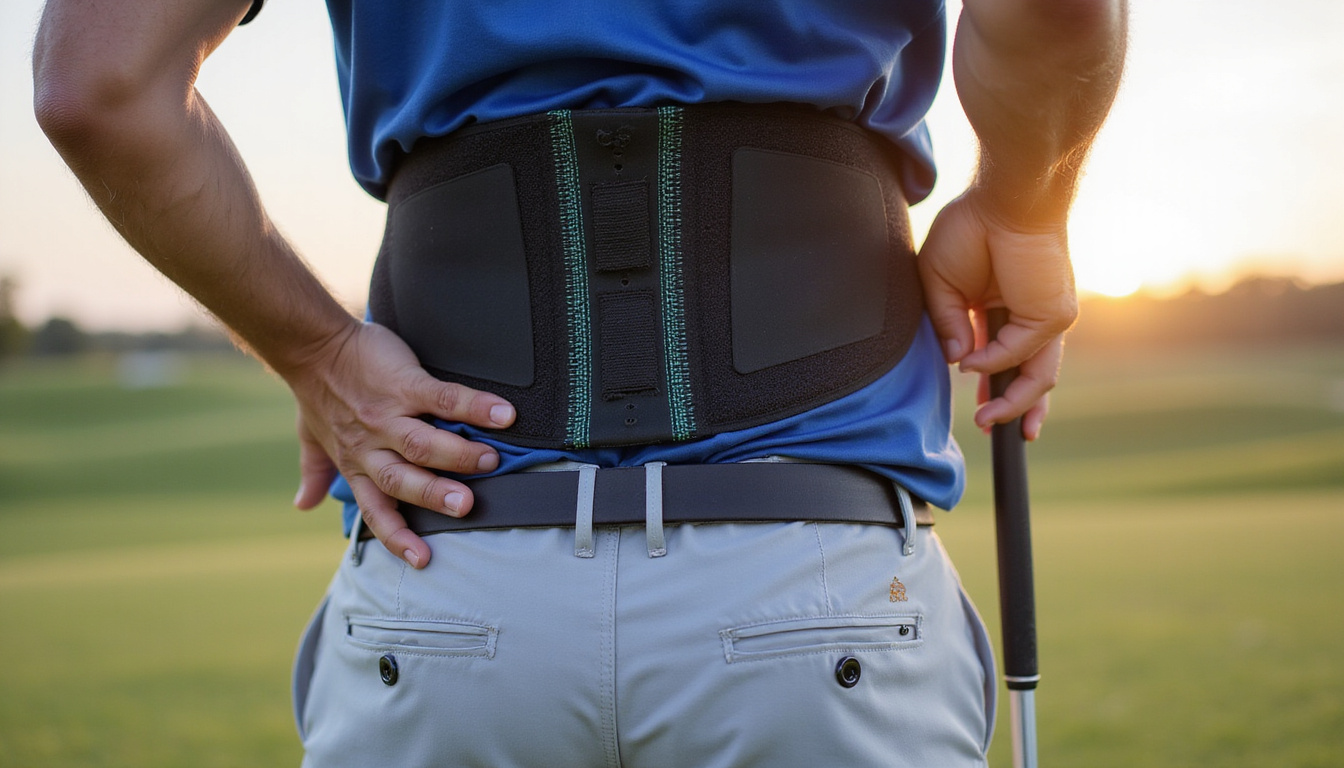
A good back or posture brace can give you a “reference feel.” It shows you what tall, athletic posture should feel like so your body can learn it.
Types of golf braces and how they influence your swing
Not all supports serve the same role. Here’s how different golf braces affect your motion and comfort.
1. Back and posture braces
These braces help if you:
- Hunch over on putts and chips.
- Struggle to keep your spine angle through impact.
- Feel your lower back tighten after a bucket of balls.
They help your swing by:
- Encouraging a taller, more athletic address.
- Helping you stay in posture instead of standing up through impact.
- Reducing unnecessary sway or slide in the backswing.
- Supporting your mid and lower back so you can rotate with ease.
They do not turn your torso into a statue. Instead, they provide just enough structure to remind you where “neutral” is.
2. Knee braces and sleeves
If your lead knee resists downhill lies or your trail knee protests after driver sessions, knee braces can change your game.
On the course, they bring benefits such as:
- Greater confidence when you post up on your lead leg through impact.
- Better stability on uneven lies and in bunkers.
- Less need to “bail out” of shots because you are guarding your knee.
- A more stable base for rotation, even on windy days.
Golfers who walk 18 or 36 holes often use light compression sleeves to stay fresh on the back nine.
3. Wrist, thumb, and elbow braces
Range rats, wedge grinders, and bunker diggers know this area well.
These braces help by:
- Supporting a repeatable wrist hinge instead of a wild flip at impact.
- Stabilizing the lead wrist so you compress the ball more.
- Reducing extra tension in your forearms so your club swings freely.
- Allowing proper grip pressure instead of squeezing the club too hard.
They allow a full or almost full range of motion with enough support to stop compensatory moves that wreck your swing.
How golf braces can “instantly” improve your swing feel
No brace turns a 20-handicap into a tour pro overnight. Still, they give you instant feedback that feels like an upgrade.
They do this in several ways:
-
Built-in swing checkpoints
A good posture brace makes clear when you slump or round your shoulders. You feel the change and self-correct at address. -
A stable base means solid strikes
Knee and ankle braces help you feel grounded, especially in windy conditions or on tricky lies. Better balance often leads to better contact and tighter dispersion. -
Less guarding and tension
When you know a joint is supported, you stop overprotecting your swing. You achieve smoother tempo, fuller turns, and more speed without forcing it. -
Reinforced swing habits at practice
Wearing braces during range sessions shows your body what “correct” is. Over time, that feeling carries over even when you are not wearing them.
Choosing the right golf brace: what to look for
Before you grab the cheapest brace at a big-box store, consider these points for golfers:
-
Range of motion for rotation
Ensure you can turn fully during both the backswing and follow-through. If you feel locked up, that brace is not for you. -
Low profile under golf apparel
Look for thin, contoured designs that fit under polos and slacks without extra bulk. -
Breathable, sweat-friendly material
Hot, sticky braces will end up in your bag by the 5th hole. Find ones that wick moisture and let air through. -
Targeted compression, not strangulation
You should feel supported, not numb. Test the tension before teeing it up. You must easily walk, rotate, and squat. -
Easy on, easy off
You might not wear braces for a full round. Choose braces you can adjust quickly between shots or holes.
Smart ways to work golf braces into your routine
To benefit from golf braces, treat them as part of a complete performance strategy rather than a band-aid.
Here is a simple plan:
-
Warm up with purpose
Do light dynamic stretches, a few air swings, and short chip shots to ready your joints. -
Use braces as “coaches”
Wear a posture brace during practice that focuses on setup and spine angle. Let it show your body what a solid address feels like. -
Adjust for walking vs. cart days
For an 18-hole walk, use knee and ankle braces with supportive shoes. On a cart day, focus on posture and back support. -
Rotate usage; don’t over-rely
Your goal is a strong, resilient body. Use braces to support movement, not to replace strength, mobility, and common sense.
Supplements and joint support: why golfers are paying attention
Many golfers now pair external support with internal support. They turn to nutrition and supplements to feel better during and after a round.
Within FDA and U.S. guidelines, dietary supplements are not meant to diagnose, treat, cure, or prevent any disease. Still, some ingredients help by:
- Supporting healthy cartilage and joint function.
- Helping maintain comfortable movement and flexibility.
- Aiding muscle recovery after activity.
- Offering antioxidant support for everyday stress from training and play.
Research shows that nutrients like collagen, omega-3 fatty acids, and certain plant compounds help joint and muscle health (source: NIH Office of Dietary Supplements).
For golfers who play many rounds, stacking smart equipment like braces with a supportive lifestyle and targeted supplements is a wise long-game move.
Regenerix Gold: internal support to pair with your golf braces
While golf braces give external support and immediate feedback, many golfers want to back that up with internal support from a premium joint and muscle supplement.
That is where Regenerix Gold fits in. Use it daily if you:
- Want to support healthy joints and muscles during play and practice.
- Care about staying mobile for a full turn even in later years.
- Aim to play pain-free golf and walk 18 holes without extra strain.
- Consider your body your most important piece of “equipment.”
Using Regenerix Gold consistently, along with proper warm-ups, smart practice volumes, and the right bracing strategy, can help you feel ready each time you step onto the first tee.
Regenerix Gold
FAQ: golf braces and performance
Q1: Do golf support braces actually help your swing?
They can. Golf braces do not replace good coaching, but they help you maintain better posture, improve stability, and reduce compensatory moves that come from discomfort. Many players feel more confident and make more consistent contact when their back, knees, and wrists feel supported.
Q2: Are golf posture braces good for practicing at home?
Yes. A golf posture brace works well for mirror practice, slow-motion swings, and setup drills. It gives you immediate feedback if you slump, round your shoulders, or lose your spine angle. It helps you build better habits that you carry over to the course.
Q3: Should I use golf knee braces if I walk 18 holes regularly?
If your knees feel tired or stressed after a round, a light compression sleeve or a golf-specific knee brace may provide the support you need. Make sure you can still rotate and squat comfortably. Pair it with good shoes, a proper warm-up, and, if needed, a joint-support supplement.
Play smarter, feel better, and protect your “swing engine”
You invest in premium drivers, forged irons, and fitted putters because they give you an edge. Your body deserves the same attention.
Use the right golf braces with a disciplined warm-up, strong swing fundamentals, and a smart supplement like Regenerix Gold. This approach sets serious, savvy golfers apart from the crowd. It is how you keep walking down the fairway when others reach for the cart too soon.
If you want to outlast your buddies, protect your “swing engine,” and enjoy golf at a high level for years, consider adding Regenerix Gold to your routine. It is a people-first, performance-minded choice for golfers. It supports healthy joints and muscles and helps you live an active life with the same intelligence that guides every shot.
Health Note
Always consult a licensed medical doctor for your health issues.
Special Discount
If you prefer preventive nutrition to minimize expensive knee surgery and potentially addictive pharmaceuticals, Regenerix Gold is your savvy solution.
You qualify for a special discount.
Simply use the link below and a discount will automatically be applied during checkout.
Get Regenerix Gold => HERE


