

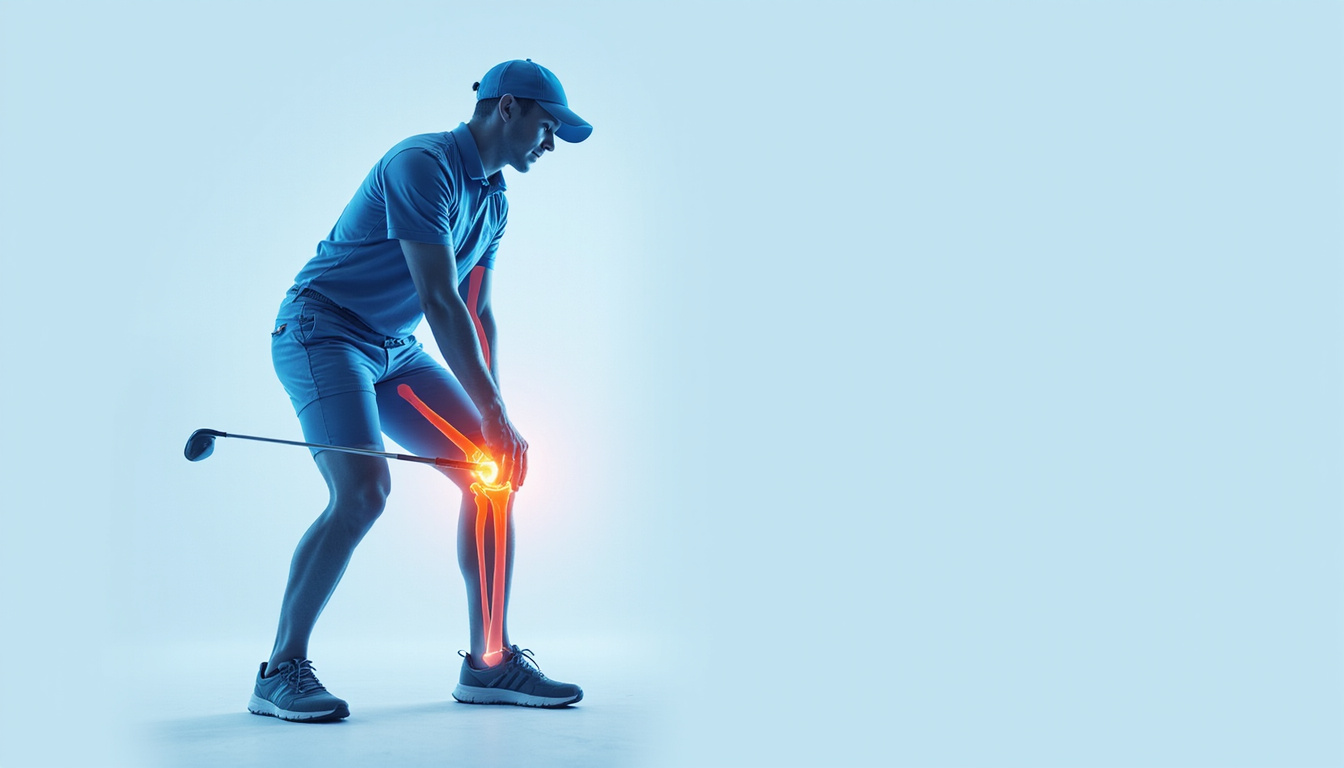
If you play many rounds, you may feel knee pain.
You log rounds. You walk courses. You grind on the range.
Your knees hurt after 18 holes, long practice, or pounding drivers on a firm mat.
Many American golfers hear whispers on the back nine and shouts by the parking lot.
Good news: with the right moves, stretches, and course tweaks, you can swing hard without costly knee pain.
Below is a practical, golfer-specific guide. It explains why your knees hurt and gives proven moves you can use between rounds to keep them strong and game‑ready.
Why Golfers Get Knee Pain in the First Place
The golf swing rotates your body. The knee acts mainly as a hinge.
When you coil on the backswing and then unwind at impact, your knees—especially the lead knee—absorb and transmit force between the ground and your hips.
Common golf‑specific stressors include:
-
Lead-knee torque at impact
Aggressive players post hard into the lead leg. This overloads the joint if muscles do not work in sync. -
Trail-knee collapse
Letting the trail knee cave in on the downswing strains the inside of the knee. -
Walking 18 on uneven lies
Sidehill lies, deep rough, and steep bunkers stress your knees more than a flat mat. -
Overuse from practice
Hitting many balls, especially off a firm mat, sends repeated shocks through the knee. -
Limited hip and ankle mobility
When these joints struggle, the knees twist more than they should.
Most golfers do not feel a sudden pop. Instead, they feel stiffness in the cart, soreness after walking downhill, or a nagging ache on a par 5. ---
Key Principles for Managing Golf Knee Pain
Before you try drills, follow these basic rules:
-
Respect pain signals
Mild discomfort is normal. Sharp or worsening pain in a swing, squat, or stretch is a sign to rest. -
Prioritize form over ego
Controlled bodyweight moves beat sloppy heavy lifts. That applies to a balanced swing too. -
Train consistently, not sporadically
Two or three short sessions a week work better than one long workout followed by days of inactivity. -
Warm up before teeing off
A quick stretch on a cart path is not enough. A dynamic warm‑up primes muscles and joints so cold knees do not face explosive moves.
If pain grows or keeps you from daily activities, talk with a health professional or a golf‑savvy therapist before you change your training.
Essential Warm-Up for Golf Knee Pain
Do a 5–8 minute warm‑up on the range or near the first tee.
This routine wakes up your hips, knees, and ankles so your joints are ready for the swing.
1. Dynamic Leg Swings (Front-to-Back and Side-to-Side)
• Hold a cart or chair for balance.
• Swing one leg front to back 10–15 times.
• Swing the same leg side to side 10–15 times.
• Repeat on the other side.
Keep the motion smooth and rhythmic. These swings wake your hip flexors, glutes, and hamstrings that support the knee.
2. Walking Knee Hugs
• Step forward.
• Hug your knee to your chest for a second.
• Alternate legs for 10–12 steps on each side.
This move loosens the glutes and upper hamstrings so your legs move better in the swing.
3. Walking Heel-to-Glute Pulls
• Step forward and pull your heel toward your backside gently.
• Hold for a second.
• Switch legs and repeat for 10–12 steps on each side.
This exercise activates the quads and improves knee flexion in a controlled way.
4. Mini Squats with Golf Club Support
• Hold your driver like a cane for balance.
• Perform 10–15 mini squats, going only as low as is comfortable.
• Keep your weight evenly distributed on both feet.
This move tells your knees and muscles, “We are about to work,” without overload.
Proven Strength Exercises to Support Your Knees
Stronger legs and hips place less stress on your knees at the top of your swing.
These exercises focus on stability and control rather than heavy lifting.
Aim for 2–3 sets of 8–12 reps, 2–3 times per week on non-consecutive days.
1. Glute Bridges
• Lie on your back with knees bent and feet flat.
• Drive through your heels and squeeze your glutes to lift your hips.
• Hold for 1–2 seconds, then lower slowly.
Stronger glutes reduce the load on the knees during rotation and push-off.
2. Wall Sits
• Stand with your back against a wall.
• Slide down until your knees form a 45–60° angle.
• Hold for 20–45 seconds, then rest and repeat.
This builds endurance in your quads and glutes for walking 18 holes and a solid impact.
3. Step-Ups (Golf Bag Height or Lower)
• Use a step 6–12 inches high or a low bench.
• Step up with one leg, push through the heel, then step down slowly.
• Keep your knee over your toes without letting it cave inward.
This move mirrors the demands of stepping in and out of bunkers or uphill walks.
4. Lateral Band Walks
• Put a resistance band around your legs (above the knees or at the ankles).
• With a slight knee bend and an athletic stance, step sideways for 8–12 steps, then back.
This targets the hip stabilizers that keep your knees from wobbling during the swing.
5. Supported Single-Leg Romanian Deadlifts (RDLs)
• Hold a chair or wall for support with one hand.
• Stand on one leg with a slight bend in the knee.
• Hinge at your hips, leaning your torso forward while extending the free leg back.
• Go only as far as is comfortable, then return to standing.
This builds balance and strength in your posterior chain, both vital for a stable, powerful move.
Stretches That Help Relieve Golf Knee Pain
After a round or practice, use these stretches to calm tight tissues around the knee.
Hold each stretch for 20–30 seconds for 2–3 rounds, and do not bounce.
1. Standing Quad Stretch
• Hold a cart or wall with one hand.
• Grab your ankle with the other hand.
• Gently pull your heel toward your backside.
• Keep your knees close and your lower back neutral.
This stretch releases tight quads that pull on the front of the knee.
2. Hamstring Stretch (Offset Stance)
• Place one heel on a low step or curb.
• Keep that leg mostly straight and hinge at your hips.
• Lean forward until you feel a stretch.
• Keep your back flat.
Looser hamstrings allow smoother hip motion and ease the load on the knees.
3. Calf and Achilles Stretch Against a Wall
• Place your hands on a wall.
• Step one foot back, keeping the heel down.
• Lean forward until you feel a stretch in the back calf.
• Bend the back knee slightly for a deeper stretch.
This stretch helps with walking stability and climbing in and out of bunkers.
4. Figure-4 Glute Stretch (Seated or Lying)
• Cross one ankle over the opposite knee.
• Gently pull the uncrossed leg toward your chest until you feel a stretch in the glute.
Releasing tight glutes reduces extra twist on the knees during your swing.
Simple On-Course Adjustments to Reduce Knee Stress
You do not have to swing “scared.” Small tweaks can ease golf knee pain while keeping your speed and consistency.
• Consider a slightly wider stance for more stability.
• Limit extreme knee flex at address; an athletic bend works best.
• Avoid forcing a massive hip–shoulder separation if your lower body feels strained.
• Use a shorter stride when walking downhill and zig-zag steep slopes.
• Use a cart or push cart on days when your knees are tender.
• Rotate through your hips and torso instead of letting your knees twist excessively.
A teaching pro or golf‑focused trainer can help you find a swing that is kind to your knees while still gaining distance.
Where a Joint & Muscle Health Supplement Fits In
Train well. Warm up smart. Use proper swing mechanics first.
Many American golfers also add a high-quality joint and muscle support supplement to aid comfort and resilience as they chase lower scores.
Regenerix Gold is made for active adults and golfers. It supports healthy joints and muscles as you log rounds, buckets on the range, and many steps on the course. It is not a treatment or cure, nor a substitute for professional care or a well-designed fitness plan. Still, when added to good nutrition, sleep, and the exercises and stretches above, it is a smart, proactive choice.
<iframe width="560" height="315" src="https://www.youtube.com/embed/mGrH5UWFxUs?si=enLOx67aeklAOHfA" title="YouTube video player" frameborder="0" allow="accelerometer; autoplay; clipboard-write; encrypted-media; gyroscope; picture-in-picture; web-share" referrerpolicy="strict-origin-when-cross-origin" allowfullscreen></iframe>
If you think about taking any supplement, talk with your healthcare provider first. Follow the label directions. The FDA does not evaluate supplements for diagnosing, treating, curing, or preventing diseases. However, it does regulate how they are made and labeled (source: FDA Dietary Supplements Overview).
Putting It All Together: A Weekly Plan for Golfers
Here is a simple weekly plan to help you manage golf knee pain while you chase birdies.
• Before every round or range session
– Do 5–8 minutes of a dynamic warm‑up (leg swings, knee hugs, heel pulls, mini squats).
• 2–3 days per week
– Do a strength session (glute bridges, step-ups, wall sits, lateral band walks, single‑leg RDLs).
• After rounds or practice
– Spend 5–10 minutes stretching (quads, hamstrings, calves, glutes).
• Daily habits
– Avoid long sitting periods right before tee times.
– Wear good shoes with proper cushioning and support.
– Consider a joint & muscle supplement like Regenerix Gold as part of your wellness plan, with advice from your healthcare provider.
FAQ: Golf Knee Pain & Joint Support
Q1: What causes knee pain after a round of golf?
A: Repeated stress from uneven fairways, bunker squats, and the swing’s rotation—especially on the lead knee—can cause knee pain. Poor strength and mobility in the hips, glutes, and ankles make the knees work harder. That is why the stretches and exercises above are valuable.
Q2: What are the best exercises for knee pain from golf?
A: Exercises that build strength and control around the hips and knees—like glute bridges, step-ups, wall sits, and lateral band walks—tend to work best. Pair these with a dynamic warm‑up and regular stretches to help manage “golf-related knee discomfort.”
Q3: Can joint supplements help with knee pain in golfers?
A: Supplements for joint and muscle health can support overall joint comfort and function when used with proper training, mobility work, and smart swing tactics. They are not medicines. They do not diagnose, treat, cure, or prevent diseases. Always consult your healthcare provider before starting any supplement.
Swing Longer, Walk Stronger: Why Regenerix Gold Appeals to Savvy Golfers
You invest in premium balls, custom‑fit clubs, and top‑shelf greens fees. Protecting your body is as important as using the latest driver.
If you think long‑term, if you want to walk 18 holes with confidence and enjoy life on and off the course, then smart training together with a joint and muscle supplement is worth considering. Regenerix Gold supports healthy joints and muscles as part of a complete plan that includes exercise, recovery, and proper nutrition. It is also ideal for anyone who wants to stay active and not sit on the sidelines.
Be the player who still moves strongly on the last hole, not just at the start. Take care of your knees. Train with focus. And consider adding Regenerix Gold to your routine as a smart, health‑savvy choice for more seasons of confident swings and pain‑free fairways.
Health Note
Always consult a licensed medical doctor for your health issues.
Special Discount
If you prefer preventive nutrition to minimize expensive knee surgery and potentially addictive pharmaceuticals, Regenerix Gold is your savvy solution.
You qualify for a special discount.
Simply use the link below and a discount will automatically be applied during checkout.
Get Regenerix Gold => HERE


